
How to Find YouTube Content Gaps with AI in 2026 (Free & Paid Tools)
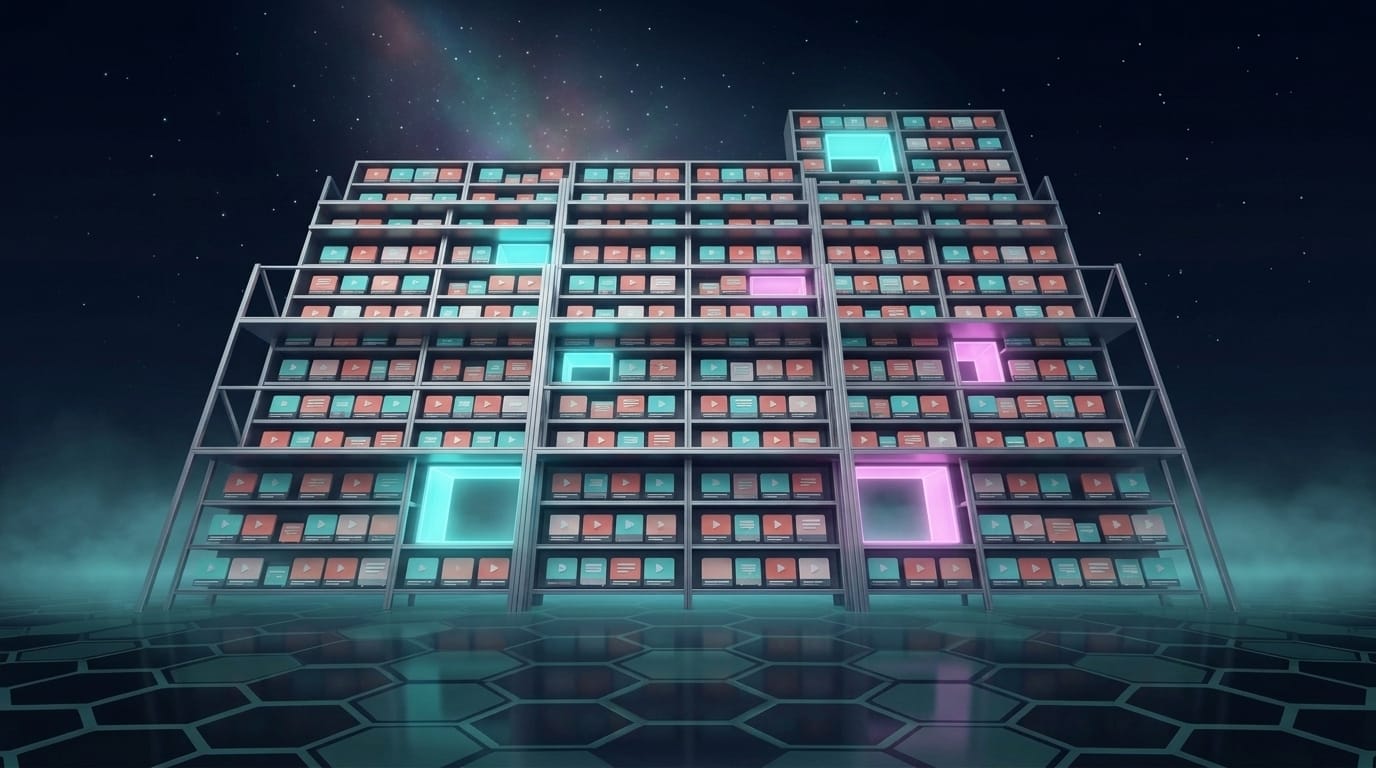
YouTube hit roughly 20 million video uploads per day in 2025, up 38% year-over-year (Teleprompter / industry tracker, April 2025). Roughly 500 hours of video go up every minute. Every creator looking at that number reaches the same conclusion: the niche is saturated, there's nothing new to make. YouTube growth strategist Roberto Blake disagrees, and he's right.
"You're not struggling as a YouTuber because you're in a 'saturated niche'. It's only saturated with low-effort content. If anything, small YouTubers struggle because of CONSOLIDATION, not saturation." — Roberto Blake on X, August 2023
The reframe matters. You're not competing with millions of channels for everything. You're competing with the top 3-5 channels in your niche for their specific angle. The space between what those top channels make and what their audiences actually ask for in the comments — that's where content gaps live.
"If your competitor has 200 comments asking variations of 'but how does this work for small businesses?' — and they're not making that video — you are."
This article is about finding them at scale.
Key TakeawaysYouTube uploads grew 38% YoY in 2025 to ~20M videos/day (Teleprompter, April 2025) — supply rises faster than most creators' content-idea pipeline.91% of creators now use AI in their workflow; 48% specifically for ideation/brainstorming (Epidemic Sound Future of the Creator Economy Report, June 2025).YouTube Studio's Research Tab has a native "Content Gaps only" filter that most creators never enable. It's a strong baseline but only sees your own channel.The gap nobody else mines: competitor audience comments. Their viewers' unanswered questions are the cleanest signal of demand that supply hasn't caught up to.
What is a YouTube content gap?
A content gap is a topic, angle, or format your target audience is asking for that few competing channels actually deliver well. The classic definition is demand-supply asymmetry: search demand exists, supply is thin or missing. In practice, gaps come in five flavors most creators learn the hard way:
- Topic gaps — entire subjects nobody in your niche has covered (or covered badly)
- Angle gaps — covered topics where every existing take feels the same; an honest contrarian read is missing
- Format gaps — the topic exists as a 30-min explainer, but nobody made the 90-second TL;DR version
- Depth gaps — surface-level walkthroughs everywhere, no genuine deep-dive
- Freshness gaps — last good treatment is 2023, the world has moved on
The reason "saturated niche" feels like a brick wall is consolidation, not real saturation. Three to five channels in your niche own 80% of the conversation; their content choices define what "available" means. Everything outside their choices is a gap. The job isn't to find untouched topics — those barely exist in 2026. The job is to find what those channels' audiences keep asking for that those channels haven't shipped.
Why manual content-gap analysis doesn't scale
Scrolling competitor videos and reading comments is the right instinct. It's also the wrong workflow for 2026. Long-form YouTube videos average 4 comments each; Shorts average less than 1 (Statista, 2024). Multiply by a realistic competitor set: 5 channels × 30 active videos × 4 comments = 600 comments per quarter, and that's before you factor in the long tail of older videos still pulling questions. Doesn't scale.
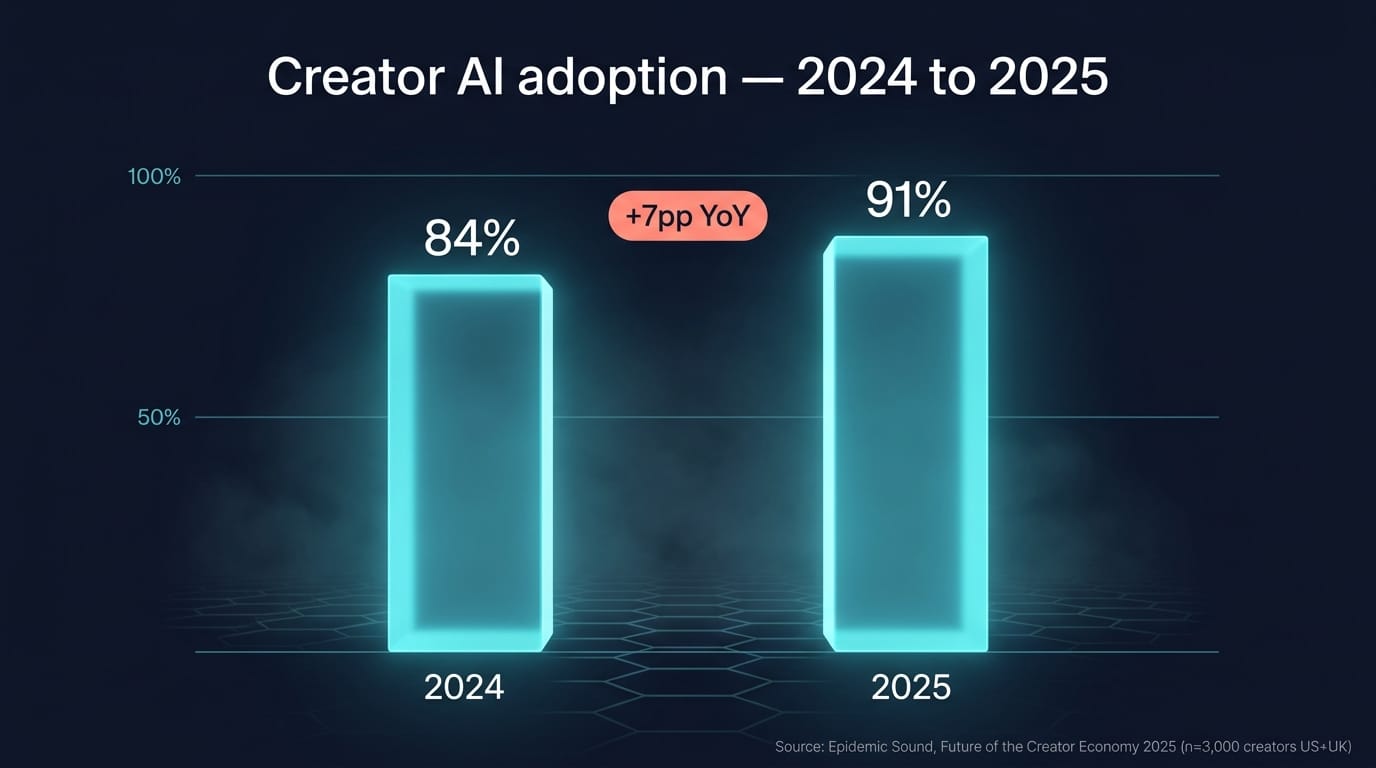
This is the gap AI tooling fills, and creators have noticed. 91% of creators used AI in some part of their workflow in 2025, up from 84% the year before (Epidemic Sound 2025). 48% specifically use AI for ideation and brainstorming. 99% see value in AI for ideation, production, or both. The shift isn't from "human ideas" to "AI ideas" — it's from "read comments slowly" to "classify comments at scale and surface the patterns."
YouTube Studio's Research Tab is the underused baseline
Before paying for a tool, check the one Google ships for free. The Research tab inside YouTube Studio has a Content Gaps only filter most creators never enable — it shows topics your audience is searching for where YouTube has few good matching results. That's a literal demand-supply gap, surfaced by the platform itself.
What the Research tab is good for: high-volume topics your existing viewers are typing into search. What it isn't: a window into competitor channels you don't own, or a way to read the comments under videos in your niche. Google won't surface either of those, by design. The Research tab answers "what's my audience searching that isn't well-covered yet" and stops there.
For a small or mid-tier channel, this is still a strong first pass. Open Studio → Research → search for your niche, flip on Content Gaps only, and you'll see queries with low matching content volume. Treat the output as a candidate list, not a content plan — many of those queries are searches because the topic is hard to cover, not because nobody thought of it.
The angle nobody else uses: competitor audience comments
The strongest signal of demand that supply hasn't caught up to isn't a search query at all. It's a question in the comments of a competitor's video that nobody — including that competitor — has answered with a follow-up video. That signal sits in a place YouTube Studio cannot show you and most tools never look: under videos on channels you don't own.
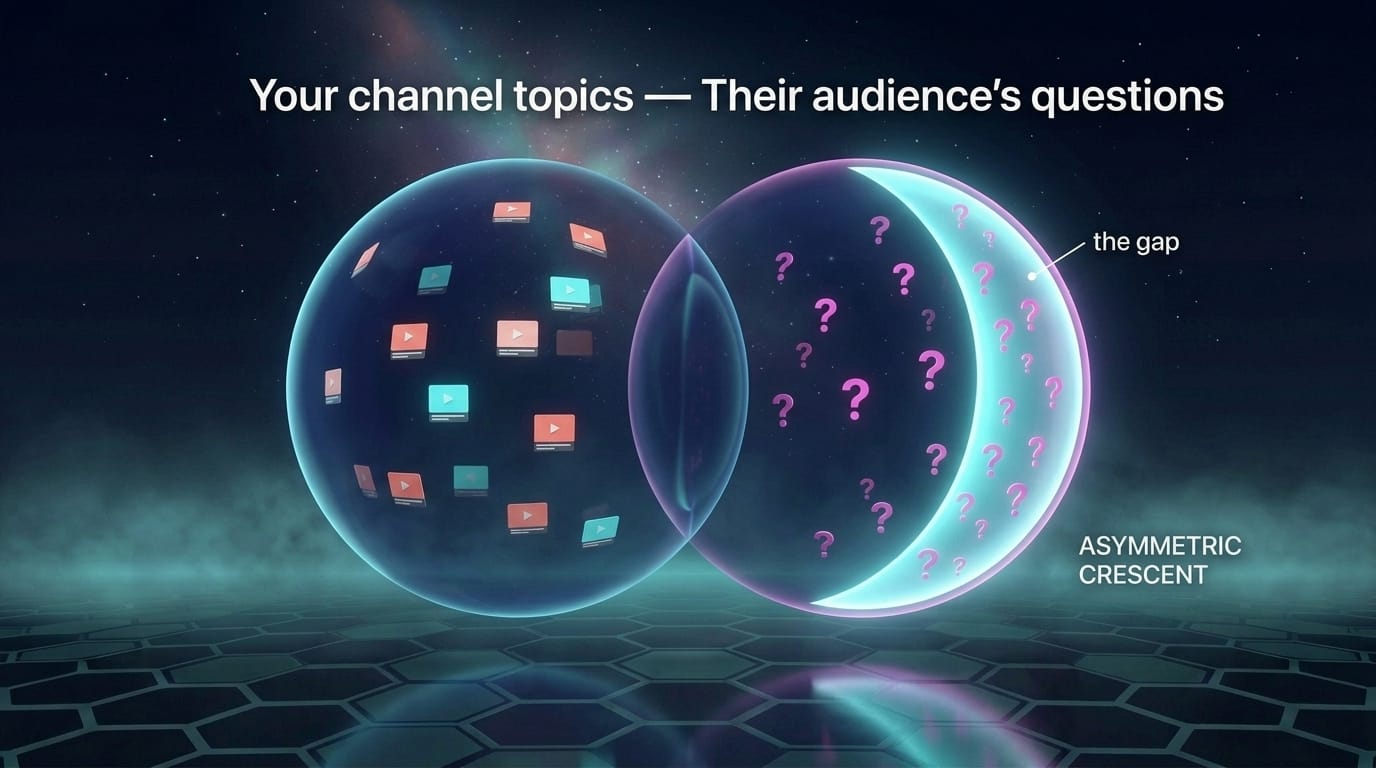
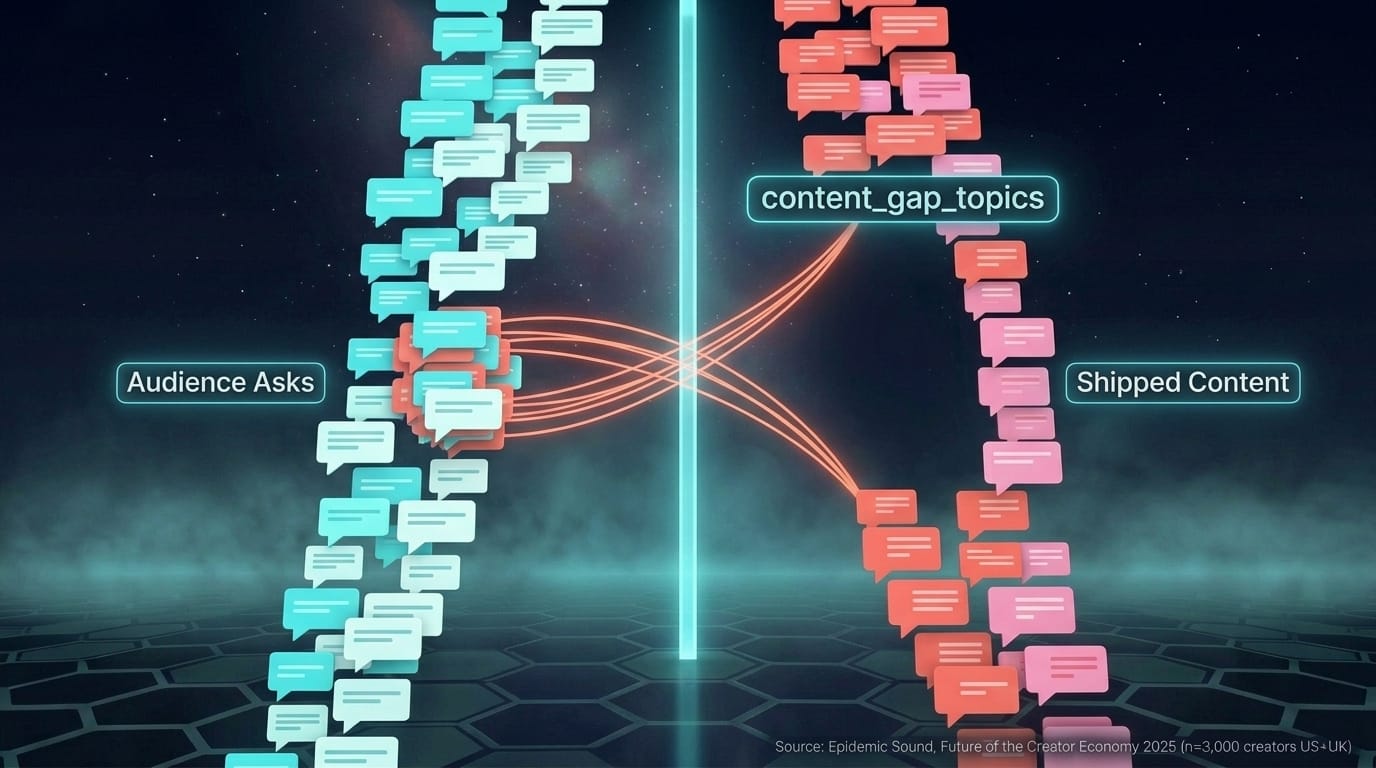
This is what OneTube's Spy Mode is built for. You add a public competitor channel to your workspace, mark it as type='competitor' instead of type='own', and the same comment pipeline runs against it. Every comment under their videos gets classified by intent and emotion (the 5-intent × 6-emotion taxonomy we walked through here), and the Pulse Report that lands afterward includes a dedicated content_gap_topics block: themes their audience is asking about that the channel hasn't covered.
The output isn't a keyword list. It's verbatim phrasing: "why does no one make a tutorial for X," "I wish they'd do a comparison of Y vs Z," "you keep promising a deep-dive on this and never do it" — the actual sentences. Ranked by frequency across videos and by emotion intensity. That's a content brief you can write a script against in an afternoon.
What we see in the data: when a competitor channel gets added to a OneTube workspace, the content_gap_topics block almost always surfaces 3-5 recurring themes the channel hasn't shipped. Sometimes more — channels that post consistently but never iterate on audience signals tend to leave the largest backlog of unfilled requests. You can't see this from outside the comment section; you have to read patterns across 50+ videos at once. The pipeline does that in minutes.AI tools for finding YouTube content gaps: an honest comparison
The "best AI tools for YouTube content ideas" listicles in this space tend to lump together everything with "AI" in the name. That's a mistake. Invideo AI and Pictory AI are video PRODUCTION tools — text-to-video, voiceover, stock-clip assembly. They generate the video once you know what to make. They do not help you figure out what to make. Wrong category.
The actually-relevant tools split into two camps: those that work from search queries (your own or industry-wide), and those that work from comment signals.
| Tool | Signal source | Competitor data | Free tier | Best for |
|---|---|---|---|---|
| YouTube Studio Research tab | Your audience's searches | No | Free (native) | Your own channel's search demand |
| vidIQ Daily Ideas + AI Coach | Keywords + algorithm signals | Partial (public stats) | Free / paid from ~$16.58/mo annual | SEO-led ideation on your channel |
| TubeBuddy Opportunity Finder | Keyword opportunity scoring | Partial | Free / paid from $4.50/mo annual | Low-competition keyword gaps |
| Semrush YouTube Gap Analyzer | Topic coverage vs competitors | Yes (by topic) | Within Semrush sub (paid) | Topic-level competitive overlap |
| ChatGPT / Perplexity | General LLM knowledge | No (no live data) | Free tier exists | Quick brainstorm from a topic |
| OneTube Spy Mode | Competitor audience comments | Yes — any public channel | 7-day trial, no card to start | Audience-asymmetry gaps |
AI audit of any YouTube channel
Drop a competitor's URL. In 5–15 minutes, get the full breakdown of what's working, what's broken, and exactly what to film next.
- 🎯Their content ideasVideos their audience keeps asking for that they never made
- ⚠️Their weak spotsExact topics and formats where viewers tune out or push back
- 💬Audience questionsStraight from their comment section — your next 10 scripts
- 📋A ready content planRanked backlog of what to film next, pulled from real demand signal
- 🔥Their superfansWho's emotionally invested in the channel and what gets them to talk
Just a URL and an email. Report lands in your inbox.
The honest version: vidIQ and TubeBuddy are excellent at SEO-driven ideation but work only on YOUR own channel — they don't expose competitor comment-section analysis as a product surface. Semrush has the strongest "topics they cover vs topics you don't" comparison but works at the keyword level, not the audience-question level. ChatGPT and AI title generators have no live comment access at all. Social listening tools (Brand24, Sprout, Awario) catch keyword-matched mentions and owned-channel inboxes, not full comment threads under arbitrary creators' videos. None of them read comments at scale across channels you don't own. That's the asymmetry. For the fuller free-tools roundup we ranked recently, we tested 5 free YouTube channel analyzers here.
Step-by-step: finding gaps with OneTube
The workflow is short. Most of the work is in the picking-which-competitors step — not the tooling.
- Add 3-5 competitor channels as
type='competitor'. Pick channels whose audience overlaps yours by 60%+ — not the biggest channels in your niche, but the ones your viewers also subscribe to. The free trial covers 5 total channels including your own. - Let the first sync complete. Comments ingest in batches; Pulse Report generation takes a few minutes per channel. Trial cadence is once per 24 hours.
- Run a Pulse Report on each competitor. Scroll past the metrics — the section that matters is
content_gap_topics. It lists 3-7 recurring questions/requests their audience has made that the channel hasn't shipped. - Cross-reference across competitors. A theme that appears in 2-3 different competitor Pulse Reports is a near-certain demand signal. One competitor missing a topic could be a deliberate niche choice. Three missing it is the gap.
- Optional: match to your own audience signal. If your channel is too small for its comments to be statistically useful (under ~1K subs, or under 100 comments per video), skip this — the whole point of Spy Mode is you don't need a big channel of your own to mine validated signal. Bigger channels can layer in: the recurring questions on YOUR channel cross-referenced against competitor gaps identifies the gaps your existing audience ALSO cares about.
For the deeper mechanics of how comments get classified before they ever surface as a gap topic, the comment-analyzer playbook we wrote covers the pipeline end-to-end.
Best practices for filling content gaps
Three rules keep gap-filling from turning into reactive content treadmill work.
Rank by frequency × emotion, not just frequency. A topic asked 3 times with grateful curiosity ("I'd love to see your take on X") is a stronger signal than the same topic asked 10 times with skeptical disappointment ("why won't anyone cover X properly"). Both are signals, but the first usually performs better on retention.
Fill with your angle, not their answer. The point of a competitor gap isn't to make the video they didn't make. It's to make the video you would make about it. The gap shows you the topic; your channel voice determines the angle. Otherwise you're a worse version of them.
Don't fill every gap. A 7-topic gap list isn't a content calendar — it's a candidate pool. Pick the 2-3 that match your existing format, audience, and production capacity. The rest go in a backlog and get re-evaluated next quarter when the gap pattern either persists or fades.
Frequently asked questions
What is a content gap on YouTube?
A content gap is a topic, angle, or format your target audience is asking for that few competitors deliver well. Gap types include topic (no coverage at all), angle (only one perspective exists), format (long-form covered but no short version), depth (only surface-level explainers), and freshness (last good treatment is years old).
How can AI help find YouTube content gaps?
AI tools classify and surface patterns at a scale humans can't match. 48% of creators in 2025 used AI specifically for ideation (Epidemic Sound 2025). The strongest signal — competitor audience comments — requires automated classification: 600+ comments per quarter across a competitor set is too much to read manually but trivial for a comment-intelligence pipeline.
Can I spy on competitor channels to find content gaps?
Yes — public YouTube channels expose their video metadata and comment threads, both fair use for third-party analysis. Tools like OneTube's Spy Mode let you add any public channel as a competitor and run the same comment-classification pipeline that runs on your own channel. The output is a content_gap_topics list of recurring questions and requests their audience has made that they haven't answered with a video.
Is OneTube free to use for content gap analysis?
The fastest free path is the Spy Mode audit — paste any competitor channel URL, get a Pulse Report by email. No card, no account needed. The 7-day trial (also no card) is the upgrade if you want to track multiple channels weekly: 5 channels including competitors, generous Pulse Report quota, full Spy Mode access. After 7 days the trial converts only if you actively choose a paid plan; otherwise the account becomes read-only.
What are the best AI tools for finding YouTube content ideas?
For SEO-led ideation: vidIQ Daily Ideas + AI Coach, TubeBuddy Opportunity Finder. For topic-overlap comparison: Semrush YouTube Gap Analyzer. For your own channel's search-demand gaps: YouTube Studio's native Research tab (free, often overlooked). For competitor audience-question gaps specifically: OneTube Spy Mode. Skip Invideo AI and Pictory AI — those are video-production tools, not ideation tools.
Sources:
- Teleprompter (industry tracker), 2025 YouTube Statistics, retrieved 2026-05-16, https://www.teleprompter.com/blog/2025-youtube-statistics
- Roberto Blake on consolidation vs saturation, X (Twitter), August 2023, retrieved 2026-05-16, https://x.com/robertoblake/status/1695803908898070981
- Epidemic Sound, Future of the Creator Economy Report 2025 (n=3,000 creators US+UK, Censuswide MRS/ESOMAR), June 2025, retrieved 2026-05-16, https://corporate.epidemicsound.com/press-and-media/press-releases/2025/content-creators-are-the-new-entrepreneurs-epidemic-sound-unveils-the-future-of-the-creator-economy-report-2025/
- Adobe, Creators' Toolkit Report 2025 (Adobe MAX), October 2025, retrieved 2026-05-16, https://news.adobe.com/news/2025/10/adobe-max-2025-creators-survey
- Statista, YouTube comments by video format 2024, retrieved 2026-05-16, https://www.statista.com/statistics/1466529/youtube-comments-by-video-format/
- Metricool, YouTube Marketing Statistics 2026, retrieved 2026-05-16, https://metricool.com/youtube-statistics/
- Buffer, The 2025 Guide to the YouTube Algorithm, retrieved 2026-05-16, https://buffer.com/resources/youtube-algorithm/
- Hashmeta, Major YouTube Algorithm Changes in 2025, retrieved 2026-05-16, https://hashmeta.com/insights/youtube-algorithm-changes-2025
- vidIQ pricing and AI features, retrieved 2026-05-16, https://vidiq.com/plans/
- TubeBuddy Opportunity Finder, retrieved 2026-05-16, https://www.tubebuddy.com/tools/opportunity-finder