
How to Find YouTube Video Ideas Your Audience Actually Wants in 2026

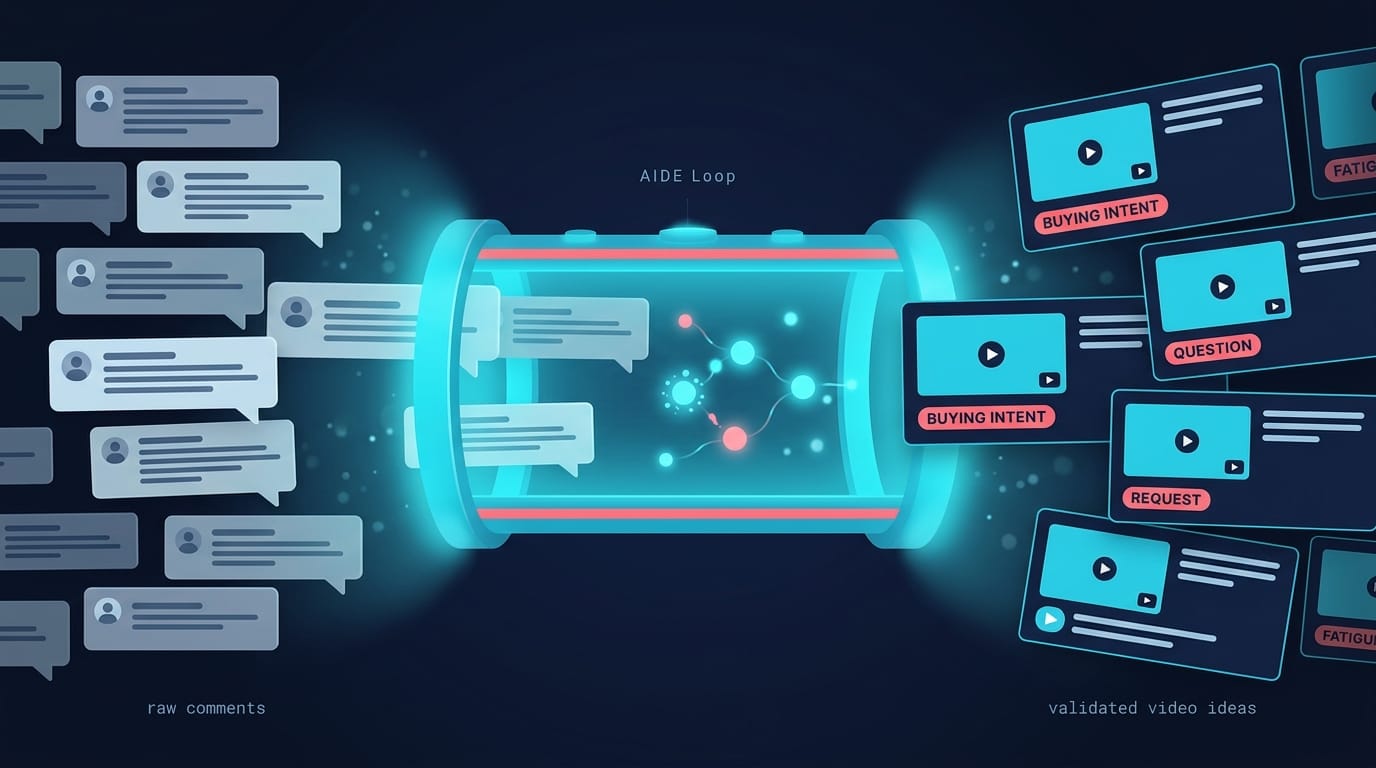
If you searched "youtube video ideas" at 11pm after a video flopped, you're not looking for a 161-item listicle. You're looking for a way to feel less stuck. The honest answer to that pain is not in a listicle. It's in your comment section, and in the comment sections of 3-5 competitor channels in your niche. This guide is the framework for turning those comments into the next 30 videos on your channel, plus an honest breakdown of why every tool on Google page one is selling you the wrong thing.
Awin's 2024 creator burnout survey (300+ creators) found 73% reported burnout "at least some of the time." The top stressor was constant platform changes (70%), the second was lack of creativity (55%). Most creators do not have an idea problem. They have a listening problem. The fix is operational, not creative.
"If your competitor has 200 comments asking variations of 'but how does this work for small businesses?' — and they're not making that video — you are."
Quick answer: What is the best way to find YouTube video ideas in 2026?
Mine the comment sections of your own channel plus 3-5 competitor channels in your niche. Cluster the comments by intent (questions, complaints, requests, hypothesis), and convert each high-frequency cluster into one video. This beats trending lists, AI generators, and keyword tools because it surfaces what your specific audience is actually asking for, not what's generally popular. The repeatable method is the AIDE Loop: Audience signals → Intent verification → Differentiation check → Execution scoring. Skip the 100-item listicles. Read the comments instead.
Why are most "video ideas" lists making your channel worse?
Google page one for "youtube video ideas" is six AI title generators and four encyclopedic listicles. None of them use your audience as input.
Here is the actual SERP top 10:
| # | Site | Type | Uses your comments? | Uses competitor data? | Risk |
|---|---|---|---|---|---|
| 1 | Veed | 105-item listicle | No | No | Generic ideas decoupled from your niche |
| 2 | StudioBinder | 161-item listicle | No | No | What to create, not how to find |
| 3 | Quickframe | 25 beginner ideas | Partial (end-of-video polls) | No | Reactive, not systematic |
| 4 | vidIQ AI Generator | AI tool | No | Claims yes, no method shown | AI-slop risk |
| 5 | Jasper | 39 ideas + framework | No | "Sort by most popular" only | Surface competitor data |
| 6 | Adobe | 20 ideas + 5-step framework | No (surveys only) | Performance only | One-shot polls |
| 7 | Renderforest AI | AI generator | No | No | Pure LLM completion |
| 8 | RightBlogger AI | AI generator | No | No | Generator admits validation needed |
| 9 | 1of10 | Outlier data | No | Video metrics only | Comment data ignored |
| 10 | TunePocket | Trend generator | No | Metadata only | Title-level only |
AI audit of any YouTube channel
Drop a competitor's URL. In 5–15 minutes, get the full breakdown of what's working, what's broken, and exactly what to film next.
- 🎯Their content ideasVideos their audience keeps asking for that they never made
- ⚠️Their weak spotsExact topics and formats where viewers tune out or push back
- 💬Audience questionsStraight from their comment section — your next 10 scripts
- 📋A ready content planRanked backlog of what to film next, pulled from real demand signal
- 🔥Their superfansWho's emotionally invested in the channel and what gets them to talk
Just a URL and an email. Report lands in your inbox.
Six of the ten are AI title generators that take a keyword and output 50 titles. Bynder's 2024 Human Touch Survey of 2,000 UK/US consumers found 50% can correctly identify AI-generated copy, and 52% disengage the moment they suspect content is AI-generated. The titles those generators output get used by tens of thousands of creators, then the videos underperform, then the creator searches "youtube video ideas" again. The loop is the problem.
There is a deeper issue. YouTube's commonly cited upload rate (Statista, corroborated across industry trackers) sits at 500+ hours per minute, roughly 720,000 hours of new content per day. In that volume, generic AI-generated topics drown immediately. The only durable signal is "this specific audience asked for this specific thing." Everything else is noise on top of more noise.
"Optimize your videos for people, not for YouTube."
Tim Schmoyer, Growth Everywhere podcast, 2018
The 2018 advice has aged better than the platforms it described. Audience-first content sidesteps algorithm chasing because the algorithm follows the audience, never the other way around.
The AIDE Loop: how to find video ideas your audience actually wants
Four steps. Each one feeds the next. Loop runs in 30 minutes once you have the inputs.
A - Audience signals (own channel and competitor channels)
Pull last 60-90 days of comments from two sources.
Source 1 (lead): 3-5 competitor channels in your niche. Pick channels with similar audience size and topic, not aspirational 50M-sub channels. Read the comments on their last 10-15 uploads. Look for: questions their creator never answered, repeated requests their channel ignored, audience friction points the competitor missed. These are your offensive content backlog — and the answer to "my channel is too small to mine its own comments" is: don't, mine the bigger channels in your niche instead.
Source 2 (if you already have a channel): your own comments. Read the comments on your last 10-15 uploads. Look for: repeated questions, repeated complaints, requests for follow-ups, hypotheses your audience tested ("I tried this and it didn't work because..."). These are your defensive content backlog. They tell you what your existing audience wants more of.
The split is structural. Sprout Social's 2025 Index (4,044 consumers surveyed Sep 2024) reports nearly three-quarters of consumers expect a brand response within 24 hours or sooner. People who post on YouTube are actively talking to you, and the 24-hour expectation means the signal decays fast. Most channels never read comments at scale because doing 5,000 comments across 5 channels by hand takes a full day. That is where Spy Mode at OneTube was built to help, but the framework works manually too if you have the time.
Shorts variant: same workflow, but pull only the last 30 days because Shorts comments decay faster. Long-form variant: 60-90 days is the right window.
I - Intent verification
You now have a list of 30-60 raw comment clusters. Not all of them are video ideas. Most are. Some are not. Verify by asking three questions.
Is this a YouTube-shaped question? Some questions live on Stack Overflow, Reddit, or a Notion doc. They are not videos. "What's the exact line of code I need to write" usually does not need a video. "How does X actually work, with a real example" usually does.
Is the intent durable? Trending topics decay in days. Audience-driven questions sit in evergreen demand for months. The 12-month video usually beats the 12-day video on cumulative views.
Does it match your channel? A finance question on a cooking channel is not your video. Your audience cares about cooking. The signal you mine has to fit the channel they subscribed to.
For each comment cluster, score 1-3 on each of these three. A 7-9 score is a confirmed video idea. A 4-6 score is a backlog candidate. A 1-3 score is noise.
D - Differentiation check
You and 200 other channels in your niche are mining the same comments. The question is what makes your version distinct. Two angles.
Angle 1: your unique data, experience, or framing. What can you say about this topic that the other 200 channels cannot say with the same authority? Personal experience, specific data, a counter-intuitive position, a unique workflow. If you cannot answer this in one sentence, the idea is generic. Send it back to the backlog.
Angle 2: the underserved sub-audience. The competitor answered this question for the 30K-sub cohort. Did anyone answer it for the 500-sub beginner cohort? For the 100K-sub professional cohort? The question is the same. The audience segment is different. Pick the segment your channel actually serves.
This step kills 30-40% of comment-cluster candidates. Good. Those generic videos would have flopped anyway. You want the 60-70% where you can deliver a real edge.
E - Execution scoring
The remaining ideas are all valid. You cannot make all of them. Score by production cost.
Time to film + edit: 4 hours vs 40 hours per video. Pick the ones you can actually ship in the next 2 weeks. The 40-hour ones go on a separate "ambition" backlog.
Production fit: a tutorial video and a face-cam reaction video need different setups. Pick the ones that fit your current production rig and don't require new gear or new skills.
Risk of underperformance: even validated ideas have variance. Mark ideas that match a format you have already shipped and that performed well as "low risk." Mark new formats as "high risk." Run 80% low-risk to fund 20% high-risk experimentation.
Output: ranked backlog of 10-15 videos ready to film, sorted by score. The loop runs again every 4-6 weeks.
How long does each ideation method actually take?
This matters because most creators have 2 hours per week for ideation, not 20. Methods that need more time than the creator has are not real options.
| Method | Time to 10 validated ideas | Idea source | AI-slop risk | Best for |
|---|---|---|---|---|
| ChatGPT "give me 50 video ideas" | 3 min | Generic LLM completion | High | Brainstorming raw lists, not validated ideas |
| vidIQ AI Daily Ideas | 5 min | Keyword + competitor metrics | Medium | Keyword-led channels |
| Google Trends + manual cross-check | 15 min | Broad trend data | Low | Trend-driven channels |
| Manual comment mining (own channel only) | 30 min | Your audience | Very low | Channels with 5K+ active commenters |
| Manual comment mining (5 channels) | 2-3 hours | Your + competitor audiences | Very low | Mid-creators 10K-500K |
| Comment mining at scale (Spy Mode pipeline) | 10 min | Your + competitor + niche channels | Very low | Mid-to-large creators, agencies |
The honest read: ChatGPT is fastest, lowest-quality. Manual mining is highest-quality, time-expensive. Spy Mode collapses the time cost without giving up the audience-signal quality. Pick the row that matches your time budget and your channel scale.
Real channels that use audience signal to drive ideas
Five public examples from different niches. Each one ships a documented workflow where audience input drives the content calendar.
Binging with Babish (Food). Andrew Rea ran a Reddit AMA on /r/Food in March 2016 explicitly to crowdsource episode ideas. The AMA directly produced the "Reddit AMA: What's Your Favorite Healthy 5-Minute Snack?" episode, which crossed 627K views by August 2017. Separately, audience-signal data showing his viewers were ~80% males 18-35 interested in cooking technique drove the entire "Basics with Babish" spin-off series.
MrBeast (Entertainment). Jimmy Donaldson routinely uses audience input as a concept-validation step before production. For Beast Games Season 3, MrBeast opened global voting so fans pick one contestant per country with a $5M grand prize. The casting itself is audience-driven, not team-driven, and the same pattern recurs on the main channel through Community-tab posts that gauge interest before a video gets greenlit.
Huberman Lab (Science). Andrew Huberman runs a formal AMA episode format where Huberman Lab Premium members submit questions directly. The submission-to-episode pipeline is published on hubermanlab.com as a member benefit. Audience signal is wired into the publishing calendar at the architecture level, not as a one-off.
Veritasium (Education). Derek Muller's video-development process starts by discussing the topic with members of the public to surface their misconceptions, then he builds the video around resolving those specific misconceptions. He has noted publicly that comment-section questions of the form "but what if X happens?" drive follow-up videos. The Scientific American profile documents this as core to the channel.
Ali Abdaal (Productivity). Abdaal maintains a structured Notion database with 133 video ideas at time of public profile, each logged with status, writer-assignment, and sponsor flag. The Every profile documents the system in detail: idea capture is treated as ongoing operations infrastructure, not a one-off brainstorm, with inputs from audience touchpoints across his channel surfaces.
Five different niches, five different production scales, one shared principle: audience input feeds the idea backlog. None of them are running ChatGPT prompts for video ideas.
How do popular video idea tools actually compare?
This is where the tool decision lands. Six methods, side-by-side. CTA after the table.
| Tool / method | Cost | Time to first idea | Idea source | AI-slop risk | Best for |
|---|---|---|---|---|---|
| ChatGPT (free / Plus) | $0-20/mo | Under 5 min | Generic LLM | High | Brainstorming sessions, not production-ready ideas |
| vidIQ AI Daily Ideas | $16.58-39/mo | Under 5 min | Keyword + competitor metrics | Medium | Keyword-led growth channels |
| TubeBuddy Keyword Explorer | $9-49/mo | 10-15 min | Search demand data | Low | Channels optimizing for search volume |
| Google Trends + manual | Free | 15-30 min | Broad trend data | Low | Trend-aware channels with time to research |
| Manual comment mining | Free | 30 min - 3 hours | Real audience | Very low | Mid-creators with time, no tool budget |
| OneTube Spy Mode + Pulse Reports | $9-99/mo | 10 min | Your + competitor + niche comments | Very low | Mid-creators and agencies running on audience signal |
vidIQ and TubeBuddy surface competitor metadata but don't expose competitor comment-section analysis as a product surface. ChatGPT can scrape a single video's visible comments via browsing but has no structured, multi-channel comment access. Listening tools (Brand24, Sprout, Awario) catch keyword-matched mentions, not full comment threads under arbitrary creators' videos. Manual mining and Spy Mode are the only two methods that read what other channels' audiences are actually asking for at scale. Spy Mode just collapses the time cost.
If your bottleneck is brainstorming raw lists, ChatGPT and vidIQ are fast and cheap. If your bottleneck is shipping videos that your audience actually wanted, comment mining is the only method that uses your audience as input. The 7-day OneTube trial (no card to start) collapses the time cost from 2-3 hours to about 10 minutes per channel batch.
What 5 ideation mistakes kill mid-creator channels?
Five anti-patterns we see repeatedly. Each one has a one-line fix.
Mistake 1: chasing the trending tab outside your niche. Trending topics get short-term views and zero retention because the audience does not match your channel. Fix: ignore trending unless it lives inside your niche category.
Mistake 2: cloning a competitor's video title verbatim. YouTube's recommendation system penalizes near-duplicate content. Fix: same audience question, different angle and framing. Take the question, not the title.
Mistake 3: "give me 50 video ideas about X" generic ChatGPT prompts. Generic LLM output has no demand validation, no audience-specific phrasing, no unique angle. Fix: feed the LLM your actual comment data as context. Generic prompt out = generic ideas out.
Mistake 4: keyword-volume-first thinking that ignores channel fit. A 10K-search keyword is worthless if your channel cannot credibly serve that audience. Fix: filter every keyword candidate through "is this what my channel is for?" before researching further.
Mistake 5: ideating before reading your own comments. Your existing audience told you what they want next. They told you in writing. They are waiting for you to read it. Fix: 20 minutes in your own comment section before any other ideation activity.
What if your channel has under 1,000 subscribers?
Comment mining your own channel does not work when you have 3 comments per video. The fix is to mine other people's comments instead.
Three sources for sub-1K creators:
Niche subreddits. People ask questions in r/learnprogramming, r/personalfinance, r/skincareaddiction, etc. Search for [the question word] + your niche. Each question is a video brief. Cite the subreddit as evidence the demand is real.
Competitor channel comment sections. This is Spy Mode applied to the early-stage problem. Pick 5 channels in your niche at any size, read their last 10-20 video comments, find the questions their creators ignored. Your channel can answer them.
Quora and AnswerThePublic. Both surface real questions people type into search engines. Quora questions track to commercial intent at lower volume. AnswerThePublic surfaces autocomplete-derived long-tail queries.
The principle holds at any sub count: audience input drives the idea backlog. Sub-1K creators just borrow audience from larger channels until their own comment volume grows.
Why are ChatGPT-generated video ideas getting demoted in 2026?
Google's December 2025 Core Update demoted thin, AI-generated content across web results, and YouTube's recommendation system applies adjacent logic to video metadata and audience-fit signals. The pattern that breaks: title generated by AI, topic generic, audience match weak, retention low, recommendation throttled.
Industry estimates put a large majority of YouTube channels at zero uploads within six months of creation. Most quit not from production quality but from ideas that did not match an audience. AI-generated ideas at scale have made this worse, not better, because they accelerate the publishing of audience-unfit content.
The fix is the same fix that worked before AI generators existed: read what your audience asks for, make that, ship it. The platform rewards videos that audiences actually wanted to watch. The audience told you what they wanted in the comments. Read them.
FAQ
How many video ideas should I have in my backlog at any time?
A healthy backlog is 15-25 ranked ideas. Less than 10 and you ship under pressure. More than 30 and ideas decay in the backlog before they get filmed. Refresh the backlog every 4-6 weeks by running the AIDE Loop again.
Is using AI for video ideas bad?
Not bad. Just incomplete. AI is fine for generating raw lists to react to. AI is dangerous when the lists go straight to production without audience validation. The rule: if you ship a video idea AI suggested and you did not see at least one real comment matching the same question, you skipped the validation step.
How do I validate an idea before filming?
Three checks: (1) at least 3 comments from your audience or a competitor's audience asking a related question in the last 60 days, (2) the topic has not been answered by a top channel in your niche in the last 90 days, (3) you can name your unique angle in one sentence. If all three pass, film it.
How often should I refresh my idea list?
Every 4-6 weeks. Comment demand shifts as your niche evolves. Ideas you generated in January feel stale by March. Re-run the AIDE Loop on a quarterly minimum, monthly if you ship 2+ videos per week.
How do mid-tier creators (10K-500K subs) actually find video ideas?
In our observation across channels at this scale: comment mining of your own last 15 videos (defensive backlog) plus comment mining of 3-5 competitor channels (offensive backlog), filtered through the AIDE Loop. Time investment: about 90 minutes manually per month, or 30 minutes with a tool that batches the work.
Are trending topics worth chasing for video ideas?
Sometimes. Trending topics inside your niche category get short-term traffic and can land new subscribers. Trending topics outside your niche category get short-term views and zero retention. The filter is niche-fit, not raw trending volume. Most channels chase the wrong half.
Can I use a competitor's video idea?
You can use the audience question that drove their video. You cannot clone their title, thumbnail, or angle. Same question, different answer. That is how niches work.
What tools do top creators actually use for ideation?
The five examples in this post (Babish, MrBeast, Huberman, Veritasium, Ali Abdaal) use a mix of: YouTube Community tab polls, AMA submissions from members, public conversations with audience members, Notion-based idea databases, and direct comment-section reading. None of them use generic AI generators. None of them publish lists of 161 random ideas. They listen, then make.
The takeaway
If you got this far, you have a method now. The AIDE Loop. Run it on your own channel and 3-5 competitor channels. Ship the ideas your audience already asked for. Skip the 161-item listicles. Stop using AI generators that decouple from real demand.
The cheapest version of the loop is 90 minutes per month of manual comment reading. The fastest version is 10 minutes per month with the free Spy Mode audit — paste a competitor's URL, get a Pulse Report by email. No card, no account needed. If reading that doesn't change how you think about next month's slate, the post wasn't useful enough and that's on us. The 7-day trial (also no card) is the upgrade for ongoing tracking across multiple channels.