
Video Ideas Generator Tools 2026: Why Most Fail (And What Actually Works)

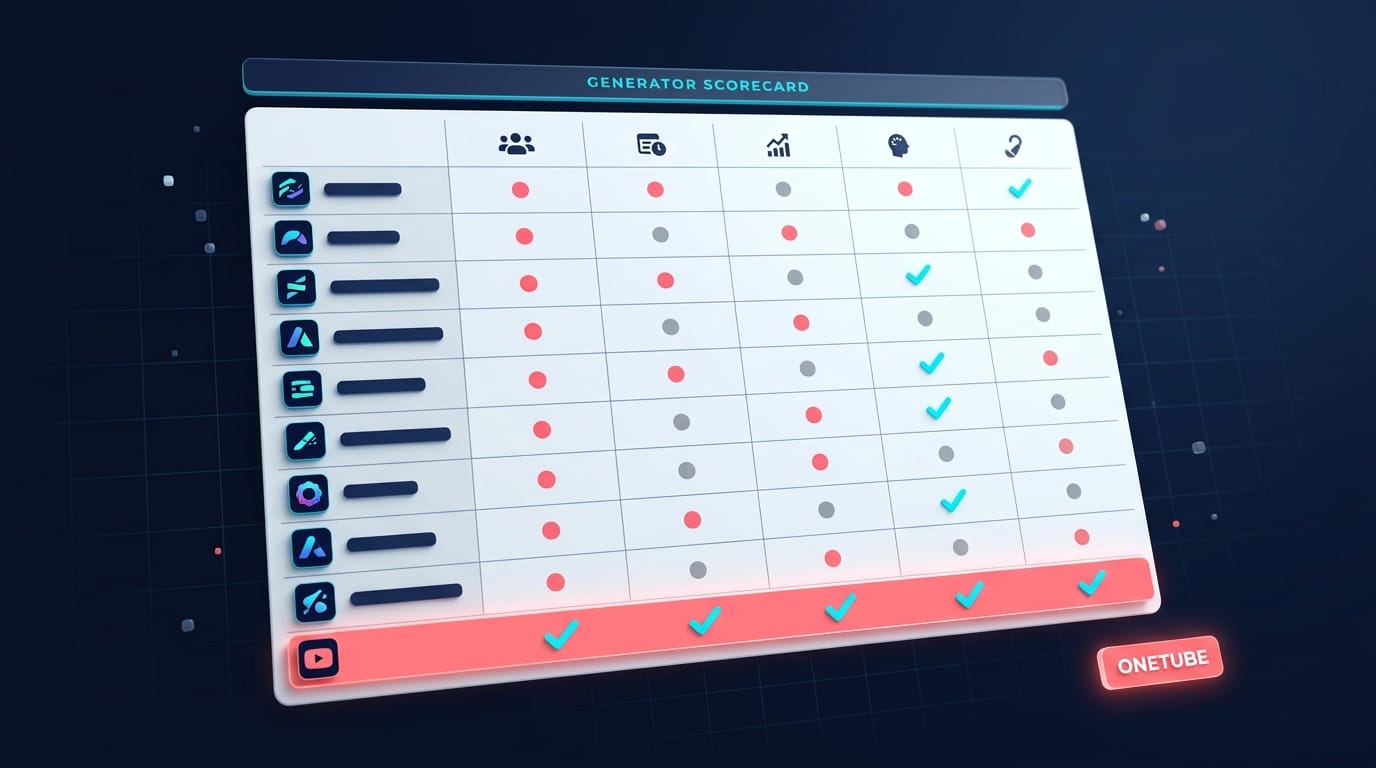
You probably have 200 video ideas saved in Notion. None of them got filmed. That is not an idea problem. That is a validation problem - and every "video ideas generator" on Google's first page makes it worse, because they all output LLM-generated titles with zero proof anyone wants to watch them.
Ahrefs' 2025 analysis of nearly 900,000 new web pages found 74.2% contain detectable AI-generated content. Adobe's 2025 Creators' Toolkit Report (16,000 creators across 8 countries) says 86% of creators now use generative AI in their workflow and 48% specifically for ideation. Idea generators are everywhere. The honest question is which ones output something usable and which ones just refill your Notion debt pile.
This guide is the teardown: a 7-criteria rubric, the same input fed into 10 real tools, the honest verdicts, and the title-to-idea bridge none of them teach you.
Quick answer: What is the best video ideas generator in 2026?
Depends on what you actually need. For free brainstorming with zero data: ChatGPT - same output every wrapper tool gives you, no markup. For SEO and keyword-volume signal: vidIQ Daily Ideas (Boost tier) or TubeBuddy Opportunity Finder. For "what is the algorithm pushing right now": 1of10 or OutlierKit (outlier-data tools). For ideas your audience literally asked for in real comment threads on real channels: OneTube Spy Mode + Pulse Reports - the only category that mines verbatim audience demand instead of inventing plausible titles. Most creators end up stacking two or three, which is consistent with Adobe's 2025 finding that 60% of creators run more than one AI tool because no single one covers every step. (Idea generators are one slice of that stack — see the full roundup of AI tools for YouTube creators.)
Why do most video ideas generators fail?
Four failure modes show up in almost every tool on Google's first page.
Failure 1: Generic LLM completion with zero data layer. RyRob, Rytr, Renderforest, Noiz, SpeakNotes, LogicBalls, and VEED all appear to wrap commercial LLM APIs without a proprietary audience-data layer underneath. In our testing of the same niche prompt across four of them, outputs clustered into the same 5-10 archetypal title patterns: "Top X mistakes", "I tried Y for 30 days", "Beginner's guide to Z". The packaging differs. The output does not.
Failure 2: No demand validation step. A title generator outputs 50 plausible titles. None of them prove anyone is searching for that topic, asking that question, or watching that format in your niche. Demand validation is the missing middle step. The tools skip it because validating is harder than completing a prompt.
Failure 3: No niche-fit filter. A "tutorial: how to build a deck" idea from a generic generator does not know if your channel is woodworking or web dev. Without channel context, every output is generic-niche. vidIQ and TubeBuddy at least connect to your channel via OAuth. The free landing-page generators do not.
Failure 4: No competitor comment signal. This is the gap nobody on the SERP closes. Competitor channel comment sections contain pre-validated audience questions - questions enough viewers cared to type out, on a channel proven to share your audience. No purpose-built generator on page one of Google reads them.
"Reach can be bought. Resonance cannot. If you want someone to stay, there's only one tactic that works: serve them."
Jay Acunzo, How to Measure Your Content's Resonance, Not Just Reach, 2021
That distinction is the whole teardown in one quote. Generic generators optimize for reach: titles that could plausibly get clicked by someone. Audience-signal tools optimize for resonance: titles that answer questions your specific niche already typed out. The tools that win in 2026 are the ones with a real data layer underneath the output.
What does a real idea generator need? (The 7-criteria rubric)
Score every tool against these seven before you pay for any of them.
| Criterion | Why it matters |
|---|---|
| 1. Demand-validated, not random | The idea ties to evidence someone is asking for this - comment frequency, search volume, or competitor performance. Not invented plausibility. |
| 2. Niche-aware, not generic | The tool knows your channel, your audience, or at minimum your niche. Generic LLM completion does not. |
| 3. Audience-signal grounded | Real comments, real questions, real engagement patterns underneath the output - not just SEO keyword data. |
| 4. Outputs angle + hook, not just title | An idea is not a title. It's a title + hook + thumbnail concept + first-30s structure. Most tools output 1/5 of an idea. |
| 5. Shows search or engagement evidence | Numbers attached to each idea: search volume, comment frequency, view-velocity signal. If you can't see the evidence, the idea is opinion. |
| 6. Filters duplicates against your channel | Does not suggest a topic you already covered. Most do not check. |
| 7. Tied to a publishing decision | Output lands in a backlog you can actually film from. Not a list dump for a Notion graveyard. |
AI audit of any YouTube channel
Drop a competitor's URL. In 5–15 minutes, get the full breakdown of what's working, what's broken, and exactly what to film next.
- 🎯Their content ideasVideos their audience keeps asking for that they never made
- ⚠️Their weak spotsExact topics and formats where viewers tune out or push back
- 💬Audience questionsStraight from their comment section — your next 10 scripts
- 📋A ready content planRanked backlog of what to film next, pulled from real demand signal
- 🔥Their superfansWho's emotionally invested in the channel and what gets them to talk
Just a URL and an email. Report lands in your inbox.
Most tools on the SERP score 1-2 out of 7. The ones that score 5+ are doing something structurally different from "wrap a prompt in a UI."
The 10 video ideas generators tested in 2026
Honest verdict per tool. Pricing verified June 2026 unless noted.
1. ChatGPT (manual prompt) - free, infinitely flexible, blind
Free tier or ChatGPT Plus $20/mo. Output depends entirely on prompt quality. With "act as YouTube strategist for finance niche, give 10 video ideas with hooks", you get titles like "How I Built $10K Passive Income in 6 Months", "The 5 Money Mistakes Killing Your 30s." Generic, no audience grounding unless you paste comments in manually.
Verdict: Use for raw brainstorming or as the engine behind any tool below - most "AI idea generators" are wrappers around this. Skip for data-grounded ideas; it will hallucinate trends and stats.
2. vidIQ Daily Ideas + AI Coach - keyword-led, locked behind Boost
Free generator on the landing page (basic). Daily Ideas + AI Coach require Boost $16.58/mo annual ($199/yr). Pulls channel content + audience demographics + trending topics + competitor keyword gaps. Output: title + search volume + competition score + outline.
Verdict: Strong on SEO and competitor-keyword gaps. Does not mine comments. Use for search-led channels. Skip if you want ideas grounded in what viewers actually wrote.
3. TubeBuddy Opportunity Finder - comment-touched, but for reply
Pro $4.50-19/mo, Legend $49/mo. Surfaces overlooked comments, retention drop-offs, missing tags, trending mentions tied to your existing videos. Touches comments - but flags them for reply, not for idea mining.
Verdict: Best as an optimizer for existing videos, not a net-new idea machine. Use for SEO cleanup on small channels.
4. 1of10 - outlier data, clone mode
Free trial (3 channels). Basic $29/mo, Pro $69/mo. Surfaces videos performing 10x-100x channel baseline. Positioning: "what the algorithm is pushing right now."
Verdict: Good for spotting proven formats to model. No audience-comment signal. Use when scaling proven patterns. Skip for differentiated, audience-validated ideas.
5. OutlierKit - niche-specific outlier search
Hobby $29/mo annual ($49 monthly), Pro $49/mo annual ($79 monthly), Max $199/mo. Similar positioning to 1of10 with a niche-focused outlier ranking. Verify pricing at checkout - the tool runs promos frequently.
Verdict: Comparable outlier alternative at similar price points to 1of10. Same structural limit: pattern-clone mode, no comment-side data.
6. Renderforest AI Generator - free, generic, fast
Idea generator is free. Renderforest paid plans (€7-49/mo as of June 2026) are for the video editor, not the ideas. Example outputs documented on the page: "A Lifestyle Traveler's Guide to Indonesia's Beaches", "10 Shopping Tips Every Beauty Lover Needs to Know."
Verdict: 30-second brainstorm starter. Pure LLM-from-keyword. Indistinguishable from a ChatGPT free-tier prompt. Skip for serious channel strategy.
7. ShortGenius - Shorts factory, miscategorized
Free with watermark (3 videos, 2 min). Paid tiers EUR 39-249/mo. Feed it an idea, it builds the Short. Not a research tool.
Verdict: Mislabeled as "idea generator." Use when you've decided what to make. Skip if your real problem is "what to make."
8. RightBlogger Idea Generator - blog-shaped, no signup
Free generator with no signup. Full RightBlogger Solo $49/mo annual ($59 monthly), Pro $69/mo annual ($89 monthly), Agency $199/mo annual ($299 monthly). Example output: keyword "healthy eating" returns "Affordable Healthy Eating: Meal Plans for $50 a Week."
Verdict: Built for bloggers, output is blog-listicle shaped. Free with no friction. Use for blog ideation or as a YouTube-title cousin.
9. TunePocket Generator - channel-metadata + 24h trend
Free (the tool itself). Reads channel handle/URL + crosses with last 24h trending searches. Outputs 5 title ideas per generation.
Verdict: Better than pure keyword tools because it reads channel context. Still no comment signal. Use as a free trend-aligned brainstorm.
10. OneTube Spy Mode + Pulse Reports - audience-signal lead
If your competitor has 200 comments asking variations of "but how does this work for small businesses?" — and they're not making that video — you are. OneTube reads that pattern automatically on any public YouTube channel. The other 9 tools in this list can't.
7-day trial. Creator $9, Pro $19, Studio $49, Agency Starter $99 per month (annual rates ~20% lower). Pulse Reports surface viewer questions, frustrations, and topic gaps clustered from real comments across your channel and the competitor channels you track in Spy Mode.
Verdict: The only tool in a different category. The other 9 are title generators or keyword tools. OneTube is YouTube comment intelligence — it reads every public comment on any channel you point it at, including channels you don't own. Output is demand-grounded, not keyword-grounded. Use when you want to make videos people are already asking for, on a competitor's channel, that nobody has answered well yet.
How do these tools score side-by-side?
The rubric, applied to all 10. CTA after the table.
| Tool | Audience signal | Competitor data | Demand validated | Niche-aware | Pricing |
|---|---|---|---|---|---|
| ChatGPT | No | No | No | No (manual) | Free / $20 |
| vidIQ Daily Ideas | No | Yes (keyword) | Search volume | Yes | $16.58/mo Boost annual |
| TubeBuddy Opportunity Finder | Partial (own comments only) | No | Partial | Yes | $4.50-49/mo |
| 1of10 | No | Yes (outlier) | Performance signal | Yes | $29-69/mo |
| OutlierKit | No | Yes (outlier) | Performance signal | Yes | ~$29-49/mo annual |
| Renderforest | No | No | No | No | Free / €7-49/mo |
| ShortGenius | No | No | No | No | EUR 39+ |
| RightBlogger | No | No | No | Partial | Free / $49-199 annual |
| TunePocket | No | No | Partial (24h trend) | Partial | Free |
| OneTube | Yes (comment-mined) | Yes (Spy Mode) | Yes (audience-question frequency) | Yes | $9-99/mo |
If you only look at Google's page one, every tool except vidIQ and TubeBuddy is the same product: LLM completion with different branding. The real choice is what data layer sits under the output: nothing (most), keyword volume (vidIQ), outlier performance (1of10 / OutlierKit), or audience comments (OneTube). Pick the layer that matches what you are actually trying to validate.
From title to idea: the 3-step bridge most tools skip
A title is not an idea. Treat generator output as raw material that needs three steps before it earns a slot in your filming calendar.
Step 1 (lead): Competitor-audience check. Does your niche actually ask this? Read 30 days of comments on 3 competitor channels in your niche. If the question appears 3+ times across channels, it has signal. If zero times, the generator hallucinated demand. This is the step every other tool skips — and the step OneTube Spy Mode automates at scale.
Step 2: Search-demand check. Google Trends 12-month rising filter + YouTube Search Suggest autocomplete + Google's "People Also Ask" box. If the topic is flat or declining, the generator's "trending" claim is wrong. Two minutes per idea.
Step 3: Angle differentiation. What can YOU say about this that the top 10 channels in your niche cannot? Personal experience, specific data, contrarian take, unique workflow. If you cannot answer this in one sentence, the idea is generic. Back to the backlog.
Generators handle step 0 (does this sound like a YouTube video). They do not handle 1, 2, or 3. Validate before filming, not after.
When should you use which tool? (Decision tree)
Quick filter based on what you actually need today.
- You need raw quantity for brainstorming → ChatGPT free or any free wrapper. Output is identical, save the $20.
- You need SEO and keyword signal → vidIQ Boost or TubeBuddy Pro+. Real search-volume data, real competitor keyword gaps.
- You want to clone what's working right now → 1of10 or OutlierKit. Outlier-pattern mining. Risk: you build a clone channel.
- You want ideas your audience already asked for → OneTube Spy Mode + Pulse Reports. Comment-mined competitor signal. The free audit runs against any competitor's channel in about 15 minutes — no card, no account needed.
- You want to test before filming → Shorts as A/B testbed for long-form, YouTube Community tab polls, pinned-comment engagement checks. These are free and they validate demand at micro-cost before you commit to a long-form production budget.
Most mid-creators end up with a stack of two: one keyword tool + one audience-signal tool. Per Adobe's 2025 data, 60% of creators are already running multiple AI tools. The right combination depends on your bottleneck.
The "50-Ideas Trap" - the anti-pattern that kills mid-creator channels
This is the single most common mistake we see. Run a generator. Get 50 plausible titles. Add all 50 to your Notion ideas database. Feel productive. Ship none of them because none of them are actually validated.
Six months later you have 200 unfilmed ideas in Notion and zero growth.
The trap is two-step: (1) generators output volume that feels like progress, (2) without the demand-validation step, none of the volume is actionable. The fix is brutally simple: kill 90% of generator output on first review. Of 20 generated titles, ship 1-3 after the validation bridge. The rest are training data for your taste, not videos.
This matters more in 2026 specifically. Ampifire's 2026 thumbnail benchmark finds thumbnails with expressive human faces outperform object-only thumbnails by 25-30% in A/B tests, and sharp, well-lit thumbnails get 27% more clicks. Generic-title videos with stock-AI thumbnails underperform across categories. The generator output that "looks fine" is exactly the output that gets throttled by the algorithm.
FAQ
What is the best free video ideas generator in 2026?
For pure LLM brainstorming: ChatGPT's free tier. Every "free AI video idea generator" on Google page one (RyRob, Rytr, Renderforest, LogicBalls, Noiz, SpeakNotes) is a thin wrapper around the same foundation models. Output quality is identical; the packaging differs. Save the click. For free signal-grounded options, OneTube offers a free single-channel audit that mines real comments from any public YouTube channel.
Can ChatGPT generate good YouTube video ideas?
ChatGPT can generate plausible-sounding titles. It cannot tell you whether your specific niche audience is asking for them. Use ChatGPT for raw quantity, then run each title through the demand-validation bridge (search check + competitor-comment check + angle differentiation) before committing to film. The titles that survive all three steps are ideas.
How do I validate a video idea before filming?
Three checks. (1) Search demand: Google Trends + YouTube Search Suggest + People Also Ask. (2) Audience-signal: 30 days of comments across 3 competitor channels in your niche. If the question shows up 3+ times, it has signal. (3) Angle differentiation: what makes YOUR version distinct in one sentence. If all three pass, film it. If two pass, backlog it. If one or zero, kill it.
Why do AI-generated video ideas underperform?
Three reasons. AI-generated titles are pulled from training data common to every other creator using the same tools, so they cluster around the same 10 templates. They have no demand-validation step, so half of them describe topics nobody is searching for. And the algorithm increasingly down-weights generic-format content, per industry observations and the broader pattern in YouTube's 2025 Inauthentic Content monetization policy update.
What is the difference between vidIQ Daily Ideas and a free AI generator?
vidIQ Daily Ideas is connected to your channel via OAuth, pulls real YouTube search volume + competition data, and recommends keyword-led topic ideas with numerical evidence. Free wrapper generators do none of that - they just complete an LLM prompt. The data layer is the difference. The free tier of vidIQ's idea generator is basically the same as RyRob; the paid Daily Ideas (Boost tier, $16.58/mo annual) is where the real signal lives.
How do I find video ideas my competitors haven't covered?
The fastest workflow: pull recent comments on 3-5 competitor channels in your niche. Cluster by intent (questions, complaints, requests). Cross-reference the questions against the competitor's own video titles. Questions that appear 3+ times in comments but never as a video title are content gaps. OneTube Spy Mode automates this end-to-end; manual works too if you have 2-3 hours per batch.
The takeaway
Most "video ideas generators" on Google's first page are LLM wrappers with no data layer. Score every tool against the 7-criteria rubric before you pay for any of them. Treat generator output as raw material, not ideas. Use ChatGPT for quantity, vidIQ or 1of10 for search and outlier signal, and OneTube for the only data layer that mines verbatim viewer demand from competitor comment sections.
If you have been hoarding generator output in Notion and shipping none of it, the gap is not your tool. It's the validation bridge between title and idea. Read the comments under your competitor's top videos. Most of your next 10 scripts are already written in there - just by viewers, not by a generator. The free Spy Mode audit is the cheapest way to test whether comment-mined ideas convert better than wrapper-generated ones — paste any competitor channel URL, no card, no account needed, get the Pulse Report by email. The 7-day trial (also no card) is the upgrade for ongoing tracking.