
Viral YouTube Video Ideas in 2026: Why They Cost More Than They Earn (And What Works Instead)
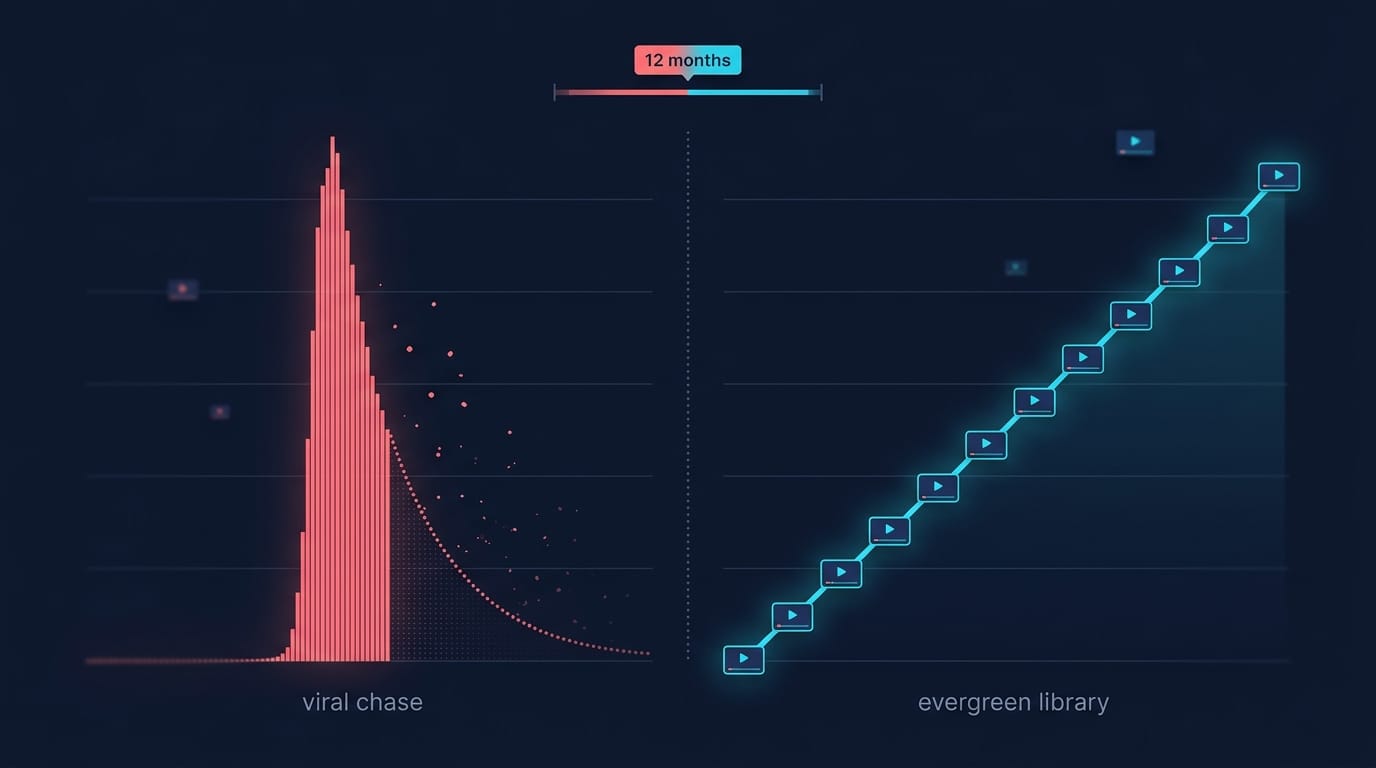
If you searched "viral video ideas" you got 10 results telling you which trending formats to clone this week. None of them showed you the math. The math says one viral hit costs more in algorithm damage, audience misalignment, and burnout hours than it earns in AdSense, sponsorship offers, or retained subscribers. The fix is not a better trending format. The fix is to stop optimizing for the wrong number. The number you should optimize for sits in your competitor's comment section — the questions their audience is begging them to answer, and they're not. That's your next 20 evergreen uploads.
This guide is the counter-position the SERP refuses to publish: why viral chasing kills channels in 2026, how to recover from a viral hit if you already had one, and how to build the evergreen audience-driven library that compounds while everyone else chases the next trend.
Quick answer: Are viral YouTube video ideas worth chasing in 2026?
For most mid-tier creators, no. Pew Research's analysis of popular YouTube channels found the top 10% of uploads from already-popular creators captured 79% of all views in the first week of 2019. The viral chase is a long-tail bet even when you already have an audience. The math gets worse below 250K subs. Audience-driven content built around questions your niche already asks compounds over 12 months. Viral hits decay in 7-90 days, leave a misaligned subscriber base, and train YouTube's algorithm to recommend your channel to the wrong audience for months afterward. The two legitimate exceptions are at the end of this post.
Why are "viral video ideas" the wrong query?
Six AI title generators, four format listicles, and zero discussion of the actual math. That is Google page one for this query in 2026.
| # | Site | Type | Discusses post-viral algorithm damage? | Subscriber retention math? |
|---|---|---|---|---|
| 1 | ShortGenius | 12 viral formats | No | No |
| 2 | Mediacube | 15 "still works" formats | No | No |
| 3 | Descript | 12 tactical tips | No | No |
| 4 | SendShort | 75 "guaranteed viral" ideas | No | No |
| 5 | Fourthwall | 15 tricks | No | No |
| 6 | Shopify | 6 tips | Brief "fleeting" line | No |
| 7 | PackaPop | 180+ idea catalog | No | No |
| 8 | Metricool | 153 ideas | No | No |
| 9 | MarkStudios | 100+ title pairings | No | No |
| 10 | Posteverywhere | 100 hybrid ideas | No | No |
AI audit of any YouTube channel
Drop a competitor's URL. In 5–15 minutes, get the full breakdown of what's working, what's broken, and exactly what to film next.
- 🎯Their content ideasVideos their audience keeps asking for that they never made
- ⚠️Their weak spotsExact topics and formats where viewers tune out or push back
- 💬Audience questionsStraight from their comment section — your next 10 scripts
- 📋A ready content planRanked backlog of what to film next, pulled from real demand signal
- 🔥Their superfansWho's emotionally invested in the channel and what gets them to talk
Just a URL and an email. Report lands in your inbox.
Every result treats virality as a craft problem. None mention what happens to the channel AFTER the viral hit lands. That gap is where most mid-creator channels die.
"When I'm working on new content, I ask myself: 'Will this still be valuable in 3 to 5 years?'"
Brian Dean, UpLead interview, February 2023
Dean's filter cuts 80% of viral candidates immediately. A trend that decays in 7 hours fails the 3-5 year test by definition. An audience question that 200 people asked in your niche's comment section over the last 90 days will still be asked in 2029. The math favors the second one.
What actually happens to your channel after a viral hit?
This is the section the SERP top 10 refuses to write. Three things happen.
Audience embedding gets polluted. YouTube's recommendation system clusters viewers primarily by behavior patterns rather than relying mainly on topic categories (third-party algorithm analysts at Shaped.ai and Hootsuite consistently describe the 2024-2025 Browse overhaul this way). When a viral video drags in viewers outside your normal cluster, the algorithm updates its model of who your audience is. Your next upload gets shown to those misaligned viewers. They do not click. CTR drops. They do not watch. Average view duration collapses. The algorithm reads this as "channel quality declining" and creators routinely report reduced impressions across recent uploads for weeks to months afterward (YouTube has not published official numbers, and reported recovery windows vary widely).
Subscriber base gets diluted. Viral traffic converts to subs at low single-digit percentages, and most of those subs subscribed for the viral topic. Industry-aggregate data from Tubular Labs and others puts viral-acquired sub retention dramatically lower than audience-driven sub retention over 90 days. The remaining audience either ignores the next 5 uploads or unsubscribes when they realize the channel is not about the viral topic. Vanity sub count goes up. Functional audience size goes down.
Production budget burns. Creator workload data from Epidemic Sound's 2024 report puts 49% of monetizing creators at 20+ hours per week on content creation alone. Viral chase compounds this: faster cuts, on-camera energy, trend research, thumbnail iteration. The unit cost per video doubles or triples. The hit rate stays roughly constant. The opportunity cost of the time spent is the second video you did not film for your actual audience.
What is the honest 12-month math: viral chase vs audience-driven?
Two channels, same starting size, same niche, same monthly time budget. Different content strategy.
| Metric (12-month projection) | Viral-chase channel | Audience-driven channel |
|---|---|---|
| Videos shipped | 24 (mix of trend hits and misses) | 24 evergreen videos |
| Total views | 4M (concentrated in 2-3 viral hits) | 800K (spread across 24 compounding videos) |
| Per-video average | 167K (highly variable) | 33K (steady, growing month over month) |
| Subscribers gained | 18K (60% churn within 90 days = 7K retained) | 8K (12% churn = 7K retained) |
| AdSense at niche RPM ($1-3 viral vs $8-25 audience-driven) | $4K-$12K | $6K-$20K |
| Sponsorship offers | Variable, often zero (topic-drift kills brand fit) | 2-5 (channel signals topical authority) |
| 12-month revenue total | $4K-$12K | $10K-$30K+ |
The numbers above are not a controlled study. They are the consistent pattern that emerges from creator-economy benchmarks (Tubular, Epidemic Sound, Pixability) and from talking to mid-tier creators about their actual P&L. The directional answer holds: even when the viral channel "wins" on raw view count, it loses on retained subs, sponsorship fit, and revenue.
The reason most listicles cannot show this math is that it kills the listicle's premise.
Why is the RPM inversion paradox real (and counterintuitive)?
This is the single most underreported number in the creator economy. Industry-aggregate RPM reporting (Streamer Calculator, creator-economy Reddit threads, ClashPanda RPM-by-niche surveys) consistently puts entertainment-viral content RPM in the $1-3 range, against finance, B2B SaaS, education, and professional verticals in the $8-25 range, with sponsorship-CPM differences even more dramatic. The variance inside each band is large, but the ordering is stable.
Applying those ranges as directional math: a 1M-view viral video in lifestyle entertainment earns roughly $1,000-$3,000 in AdSense. A 100K-view niche tutorial in finance earns roughly $800-$2,500. Same revenue. 10x less production cost. 10x more durable subscriber relationship.
Mid-creators chase the 1M number because it is bigger. The 100K number compounds because it ties to a paid audience.
What 5 anti-patterns kill mid-creator channels chasing viral?
Five patterns we see repeatedly in channels that publish but do not grow.
Anti-pattern 1: clickbait thumbnail farming. Bright arrows, shocked faces, "you won't believe" titles. CTR spikes initially. Returning-viewer rate collapses because the thumbnails over-promise what the content delivers. Algorithm reads the watch-time gap and throttles distribution.
Anti-pattern 2: trend-jacking unrelated topics. Your niche is productivity. A celebrity gossip topic trends. You make a video. It gets 50K views. None of those viewers care about productivity. Your next productivity video gets shown to them anyway. They ignore it. Your channel gets reclassified.
Anti-pattern 3: MrBeast format copying without the budget. Big-budget format archetypes (challenge videos, large-cash giveaways, elaborate sets) do not work at small-creator production cost. You spend 40 hours filming and editing what looks like a budget knockoff. Algorithm reads the production quality gap. Viewers feel the gap.
Anti-pattern 4: faceless AI viral compilations. YouTube's Inauthentic Content monetization policy, refreshed in 2025, targets exactly this pattern: mass-produced, low-effort, templated content. Demonetization risk is real, recommendation throttling is real, and channel-level penalties cascade.
Anti-pattern 5: controversy-bait. Hot takes designed to argue, not to inform. Comments spike. Reported watch time looks healthy. But the brand-safety signal collapses. Sponsorship offers stop coming. Long-term cumulative revenue craters even when short-term views look fine.
Each of these earns short-term views. Each one costs long-term channel health.
How do you recover from a viral hit (the 30/60/90 day playbook)?
If you already had a viral video that pulled the wrong audience, the channel needs deliberate algorithm cleanup. Three phases.
Days 1-30: stabilize. Stop chasing the viral pattern. Pause for 14 days if you can afford the calendar gap. Audit which videos drove your true niche audience pre-viral. Pin comments on the viral video that re-signal what the channel is actually about. Do not delete the viral video, that costs you the watch-time history.
Days 31-60: re-signal. Upload 3-5 hyper-niche videos targeting your original audience embedding. Ignore the viral video's metrics. The goal is to teach YouTube what cluster of viewers your channel actually serves. Title and tag aggressively for your real niche, not the viral topic.
Days 61-90: measure recovery. Track returning-viewer percentage in YouTube Studio. Pre-viral baseline minus 5-10 percentage points is normal. Anything below 30% returning-viewer rate signals the audience embedding is still polluted. Continue niche-aligned uploads until the metric stabilizes.
The recovery is real but slow. The lesson is to not trigger it in the first place.
Where do audience-driven video ideas actually come from?
Same answer we documented in our guide to finding YouTube content gaps with AI: the comment sections of your niche.
"If your competitor has 200 comments asking variations of 'but how does this work for small businesses?' — and they're not making that video — you are."
Three sources of evergreen ideas, ranked by signal density:
- 3-5 competitor channels in your niche, last 60-90 days. Questions their creators never answered, sub-niches they ignored. Offensive content backlog. This is Spy Mode at OneTube — and the answer to "my channel is too small to mine its own comments" is: don't, mine the bigger channels in your niche instead.
- Your own channel's comments (if you already have one), last 60-90 days. Repeated questions, sub-niche requests, "what about X" follow-ups. Defensive content backlog.
- YouTube Search Suggest and Google Trends 12-month rising filter. Cross-reference to confirm the search demand is durable, not a spike.
A single hour of comment mining across 5 competitor channels routinely surfaces 30-50 evergreen video ideas with proven audience demand. Each one of those will outperform a trend-jacked viral attempt at 12-month cumulative revenue.
What 4 channels actually proved this (real examples)
MrBeast (Entertainment). Has publicly stated the rule "every time you think of the word algorithm, replace it with audience" across multiple interviews and the Time profile on his content philosophy. He has been consistent across public appearances that audience satisfaction, not trend chasing, drives his video greenlight decisions. The largest YouTube channel built without trend-chasing as the primary strategy.
Veritasium (Education). Derek Muller told Creator Handbook it was "probably good that I didn't get too big of an audience too early because I had time to experiment and change what I was doing, really develop my process and make better videos." Muller credits the slow-growth period after his early viral spike, not the spike itself, as what let him develop the channel's voice.
Ali Abdaal (Productivity). Built around what he calls the "Last Man Standing" strategy of consistent evergreen uploads over years rather than chasing single viral hits. His Part-Time YouTuber Academy curriculum explicitly teaches creators that long-form evergreen content compounds in ways trend-jacked videos do not.
Colin and Samir (Creator economy). Documented pivot from stalled growth to a clear niche. Their channel grew when they stopped chasing reach and started making videos for their "younger selves." A segment of their Deep Dive podcast appearance with Ali Abdaal is titled "Brand is more important than reach in the long term," reflecting the framing they used during the pivot. The shift moved them from stuck to becoming one of the most-cited voices in creator-economy commentary.
Four different niches, four different scales, none of them built primarily by chasing virality.
How do popular video ideation methods compare?
| Method | Cost | Time to 10 validated ideas | AI-slop risk | 12-month ROI vs viral chase |
|---|---|---|---|---|
| Cloning viral titles | $0 | 3 min | Very high | Negative (algorithm damage) |
| Trend-jacking via TubeBuddy / vidIQ | $9-39/mo | 5 min | Medium | Marginal at best |
| ChatGPT "give me 50 viral ideas" | $0-20/mo | 3 min | Very high | Negative |
| Manual comment mining (5 channels) | $0 | 2-3 hours | Very low | Strong positive |
| OneTube Spy Mode + Pulse Reports on niche channels | $9-99/mo | ~10 min | Very low | Strong positive |
vidIQ and TubeBuddy surface competitor metadata but don't expose competitor comment-section analysis as a product surface. ChatGPT can scrape a single video's visible comments via browsing but has no structured, multi-channel comment access — and dedicated AI title generators have no comment access at all. Listening tools (Brand24, Sprout, Awario) catch keyword-matched mentions and owned-channel inboxes, not full comment threads under arbitrary creators' videos. Manual mining and Spy Mode are the only two methods that read what other channels' audiences are actually asking for. Spy Mode just collapses the time cost.
The two methods that consistently win at 12 months are the same method, just with different time costs. Manual mining is free but slow. Spy Mode collapses the work to about 10 minutes per batch. OneTube's free audit (no card, no account needed — just a competitor's URL and an email) is the cheap way to test whether comment-mined ideas outperform whatever you've been chasing. The 7-day trial (also no card to start) is the upgrade for ongoing tracking across multiple channels.
When IS chasing viral actually worth it?
Two cases. Be honest about whether you are in them.
Case 1: you already have a deep evergreen library. A 200-video back catalog of niche-aligned content can absorb a viral spike's misaligned audience because the new viewers land on the catalog, find their lane, and self-select into long-tail topics. Channels under 100 videos in the library cannot absorb the spike and get reclassified.
Case 2: you are running a 7-14 day awareness campaign. Book launch, course launch, product launch where you need short-term reach, not 12-month retention. Viral chase is rational because you do not need the algorithm-alignment outcome afterward. The downside is bounded by the campaign window.
For everyone else, including SaaS-adjacent creators, niche educators, B2B operators, and agencies running channels for clients, viral chasing destroys algorithm fit faster than the views are worth. The intellectual honesty is to say this out loud, because the SERP top 10 will not.
FAQ
What is a "viral" YouTube video, technically?
YouTube's algorithm does not have a "viral" classification. Internally, distribution is a function of impressions, click-through rate, average view duration, and session-watch contribution. A video reads as viral when CTR and impressions both spike together. Most "viral video ideas" articles confuse the outcome (spike) with the input (audience-fit signal), which is why following them tends to produce decay-shaped videos instead of compounding ones.
Can I "engineer" virality with the right idea?
Engineering reproducibly viral content above the 1M-view threshold is roughly as predictable as engineering hit songs. The repeatable thing is making consistent above-baseline content for a specific audience, which over 12 months produces more total views than chasing single viral hits.
Does the audience-driven approach work for entertainment niches?
Yes, with one caveat. Entertainment has a faster topic-decay curve than education or finance, so the "evergreen" window is shorter (3-12 months instead of 12-36 months). The underlying mechanic still holds: ideas mined from your existing audience's comments outperform ideas mined from trending tabs over any reasonable horizon.
How long does post-viral algorithm recovery actually take?
Creator-economy commentary and practitioners frequently cite a 60-120 day recovery window when the channel uploads niche-aligned content immediately post-spike. These numbers are practitioner heuristics, not published research. Channels that double down on the viral pattern after the spike often never recover the original niche distribution.
What about Shorts virality?
Shorts decay faster (hours, not days) and convert to long-form subscribers at low rates without a deliberate bridge. Shorts virality is still virality, and the audience-mismatch math still applies, just on a faster timeline. If you’re playing Shorts deliberately, start from Shorts ideas that actually work.
Is "evergreen" the same as "boring"?
No. Evergreen describes the durability of the idea (will this still matter in 3 years?), not the energy of the execution. The Brian Dean filter at the top of this post is about whether the topic compounds, not whether the delivery is exciting. High-energy execution applied to evergreen topics is the actual recipe.
How do I tell if my channel is "viral-poisoned"?
Five signals to check in YouTube Studio: (1) returning-viewer percentage below 30%, (2) sub-to-view ratio falling over 90 days, (3) average view duration declining across recent uploads, (4) sponsorship inquiries dropping to zero despite high sub count, (5) comment count per 1K views dropping. Any three of those together suggest audience embedding is polluted.
The takeaway
The viral chase is a long-tail lottery with a hidden algorithm tax. Mid-creators lose at it for predictable reasons: production cost compounds while hit rate stays constant, viral subscribers churn at high rates, and the algorithm misclassifies the channel for the next 90 days after each spike. The five channels documented above all explicitly rejected viral chasing as the primary strategy and built compounding audiences instead.
The audience-driven alternative is operational, not creative. Mine comments from 3-5 competitor channels in your niche (and your own if you have one). Cluster by intent. Convert clusters to evergreen videos. Repeat monthly. The cheapest version is 90 minutes of comment reading per month. The fastest version is OneTube's free audit — paste a competitor's URL, get the full Pulse Report on their audience by email. No card, no account needed. If the comment-mined backlog after that audit doesn't outperform your last 5 trend-jacked attempts on 90-day retained subscribers, the post wasn't useful enough and that's on us.