
YouTube Shorts Ideas in 2026: 6 Hook Patterns and a Comment-Driven Pipeline That Actually Work
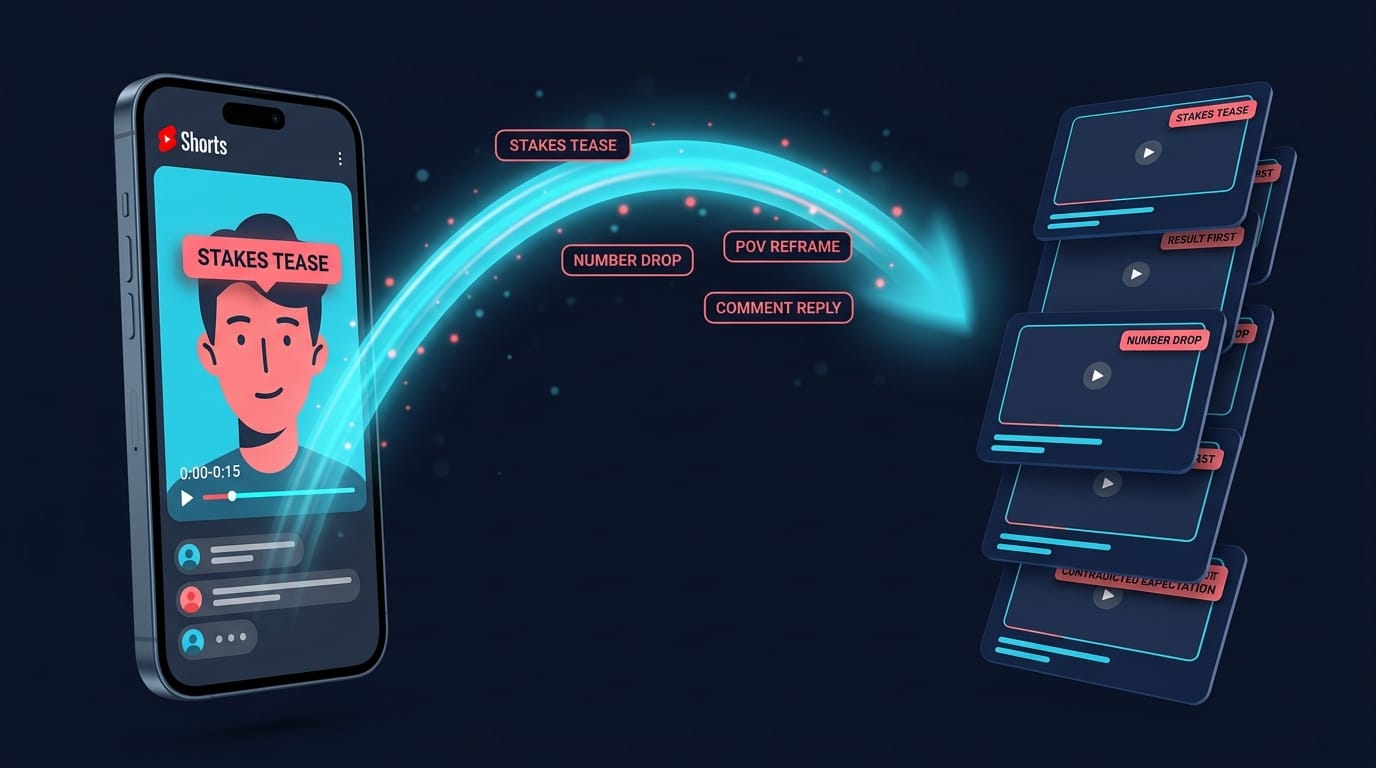
YouTube Shorts hit 200 billion daily views in 2025 per Neal Mohan's Cannes Lions keynote, roughly triple the pace YouTube reported in early 2024. The format is now the largest discovery surface on the platform. The problem most creators have is not finding Shorts ideas in general. It's that they're guessing what their niche wants while their competitor's last 10 Shorts have 800 comments telling them. Read those comments. The Short their audience asked for — and they didn't make — is the one you ship next.
"If your competitor has 200 comments asking variations of 'but how does this work for small businesses?' — and they're not making that video — you are."
Finding Shorts ideas that hold the first second, loop the last frame into the first, and pull a subscriber across to the long-form channel is a different ideation problem than long-form, and most "youtube shorts ideas" listicles do not solve it.
This guide is the operating manual: 6 hook patterns with documented examples, a niche-specific ideation matrix, the Shorts comment-to-Shorts pipeline, anti-patterns that kill channels, and the honest monetization math for 2026.
Quick answer: How do you come up with YouTube Shorts ideas that work in 2026?
Two inputs. First, scan the comment sections of 3-5 successful Shorts in your niche on competitor channels. Cluster the comments into recurring questions, complaints, and reactions. Each cluster becomes one Short. Second, apply a hook pattern from the library below (Stakes Tease, Result-First, Number Drop, Contradicted Expectation, POV Reframe, Comment-Reply) inside the first second. Most "shorts ideas" lists hand you formats. You need a hook + a comment + a niche fit. The AIDE Loop for long-form does not translate directly. Shorts ideation has its own pipeline.
What makes YouTube Shorts ideas structurally different from long-form ideas?
Three differences. Each one rewrites the ideation playbook.
Hook window is one second, not thirty. Long-form gives you 30 seconds to set the stakes. Shorts gives you under a second of visual signal before the viewer swipes. Jenny Hoyos, a Shorts creator widely profiled for repeatedly clearing 10M+ views per Short, told YouTube's official blog the rule plainly:
"I really do think you have one second to hook someone, especially on Shorts."
Jenny Hoyos, YouTube Shorts deep dive, January 2025
That changes ideation. Every Shorts idea has to be expressible as a first-second visual. If you cannot describe the first frame in one sentence, the idea is not Shorts-shaped yet.
Retention bar is higher. Shorts retention runs materially higher than long-form because the swipe-cost is one frame. Creator-tool analyses consistently put the bar around the 70%+ range for distribution. Long-form lets you build slowly. Shorts demands the payoff is visible from frame one.
Comments are denser, faster, more reactive. A long-form comment can be a 200-word reflection. A Shorts comment is a Twitter-shaped beat: a single question, a single complaint, a single joke, a single hot take tied to a precise moment in a 30-second video. Per-comment signal density is higher than long-form. Comments under top Shorts in your niche are the most underused ideation surface on YouTube. None of the listicle pages ranking for "youtube shorts ideas" mine them.
Where do Shorts ideas actually come from in 2026?
Three sources, ranked by signal density.
Source 1 (lead): comments under 3-5 competitor channels' top 10 Shorts. Pick channels in your niche, read the comments on their top-performing Shorts. Look for: questions their creators never answered, repeated requests their channel ignored, jokes that landed (those audiences want more of the same emotional beat). This is your offensive Shorts backlog — and the answer to "my channel is too small to mine its own comments" is: don't, mine the bigger channels in your niche instead. This is where Spy Mode at OneTube earns its name.
Source 2: comments under your own last 10 Shorts (if you already publish Shorts). Skim them in 10 minutes. Look for: questions your video did not answer, sub-niche requests ("do this for [adjacent topic]"), substitutions ("can I swap X for Y?"), and corrections ("you missed Z"). These are your defensive Shorts backlog.
Source 3: TikTok native trends in your niche. Financial Times data surfaced via Backlinko puts global TikTok users at 95 minutes per day, more than any other social platform. TikTok is where short-form ideation happens first. Watch your niche there, then adapt for Shorts (longer captions, no platform-native sounds, hooks re-timed for YouTube's faster swipe-away). Source 3 is third because it is slower and lower-signal than mining your audience directly.
The single highest-impact habit: 20 minutes a week in Sources 1 and 2 generates 30-50 Shorts ideas. Most channels skip both because reading comments by hand at scale is operationally expensive without a tool that batches the work.
The 6 hook patterns that work on YouTube Shorts
Hook libraries beat hook tips. Below: six patterns that recur in top-performing Shorts across niches, with the timestamp where each one fires and a real creator who runs the pattern.
1. Stakes Tease (0-1s)
Show the visual outcome immediately, but cut before the payoff. Viewer stays for the resolution. Short-form coach Ernesto Perez, who has worked with creators including MrBeast, formalised this in the Colin and Samir playbook as the Stop, Hook, Payoff Method.
Looks like: "What if I told you I built X in 60 seconds?" with the finished X already visible behind the speaker.
2. Result-First (0-1s)
Lead with the outcome, then explain how. Reverses storytelling. Works in education and tutorial niches because the viewer self-selects on the result.
Looks like: a fully cooked dish in frame zero with the caption "this took 45 seconds, here's how."
3. Number Drop (0-2s)
Specific number in the first sentence. Numbers create concrete stakes that round phrases do not. Creator strategist Neel Dhingra's breakdown of Alex Hormozi's content patterns describes a recurring outcome-plus-number-plus-timeframe formula ("how I made $X in Y days") that Hormozi's Shorts run on repeatedly.
Looks like: "$0 to 10,000 subs in 90 days using one tactic."
4. Contradicted Expectation (0-3s)
State a belief the audience holds, then reverse it. Forces a "wait, what" moment that buys retention. Education and finance Shorts use this constantly.
Looks like: "Everyone says to do X. Here is why X is wrong for you."
5. POV Reframe (0-3s)
Position the viewer inside a scenario. The "POV:" opener telegraphs a frame the audience instantly grasps.
Looks like: "POV: you just got the email" with on-screen text showing the email.
6. Comment-Reply (0-2s)
Screenshot a comment from your own Shorts or a competitor's, then answer it on-camera. The comment IS the hook. Viewer recognises the question and stays for the answer.
Looks like: comment screenshot full-frame "is X better than Y?" then cut to the creator answering with stakes.
Pick one pattern per Short. Picking two at once compresses both into noise.
Which hook pattern fits your niche?
Hook patterns are not niche-neutral. Education and entertainment use different shapes. The matrix below maps hook patterns to the niches where they consistently land in 2026.
| Niche | Best hook patterns | Mini-example |
|---|---|---|
| Education / Tutorials | Result-First, Contradicted Expectation | "This 10-second fix beats every productivity app" |
| Entertainment / POV | Stakes Tease, POV Reframe | "POV: your boss said the quiet part out loud" |
| Reviews | Result-First, Number Drop | "$1,200 phone, one specific gripe, full verdict" |
| Vlog / Lifestyle | POV Reframe, Comment-Reply | Comment screenshot "how do you stay productive while traveling" then in-frame answer |
| Finance / Business | Number Drop, Contradicted Expectation | "$0 to $10K MRR in 60 days, here is the boring tactic" |
| Fitness | Result-First, Stakes Tease | "Most people do this push-up wrong. Fix in 7 seconds." |
AI audit of any YouTube channel
Drop a competitor's URL. In 5–15 minutes, get the full breakdown of what's working, what's broken, and exactly what to film next.
- 🎯Their content ideasVideos their audience keeps asking for that they never made
- ⚠️Their weak spotsExact topics and formats where viewers tune out or push back
- 💬Audience questionsStraight from their comment section — your next 10 scripts
- 📋A ready content planRanked backlog of what to film next, pulled from real demand signal
- 🔥Their superfansWho's emotionally invested in the channel and what gets them to talk
Just a URL and an email. Report lands in your inbox.
Pick the column that matches your niche. Pick a hook from your column. Mine your audience for the topic. Three decisions, in that order, ship a validated Shorts idea in under five minutes.
The Shorts comment-to-Shorts pipeline
This is the workflow no listicle covers because most listicles do not separate Shorts ideation from long-form ideation.
Long-form pipeline: pinned audience question → 8-minute video answering it with B-roll and chapters. Works for long-form. Does not work for Shorts because the production cost is wrong and the hook window is wrong.
Shorts pipeline: comment screenshot → 15-second reply Short. Same insight, different production shape.
Four-step Shorts pipeline:
- Pull last 30 days of comments from 3 competitor channels in your niche (and your own, if you already publish Shorts). Shorts comments decay faster than long-form, so a 60-day window is too wide.
- Cluster by intent: questions, complaints, requests, reactions. Each cluster of 3+ comments saying the same thing is one Shorts brief.
- Match each cluster to a hook pattern from the library above. A "wait, you missed X" comment cluster → Contradicted Expectation hook. A "how do I do Y" cluster → Result-First hook. A "I tried this and it failed because" cluster → Comment-Reply with the failure-story screenshot.
- Ship 10 Shorts from one batch. Each Short is 30-90 seconds of production time once the comment cluster is identified. Batch ideation, batch shoot, batch publish.
This is OneTube's distinctive angle on Shorts ideation. Comment classification at the cluster level is what Pulse Reports do natively on any public channel via Spy Mode.
How do the popular Shorts ideation tools compare?
Tools are not equal. Most that rank for "youtube shorts ideas" are AI title generators or trend feeds. The decision is what input the tool actually uses.
| Tool / method | Cost | Input source | Time to 10 ideas | Best for |
|---|---|---|---|---|
| ChatGPT prompt "give me 50 Shorts ideas" | $0-20/mo | Generic LLM | Under 5 min | Raw brainstorming, not production-ready |
| vidIQ Trend Feed / AI Daily Ideas | $16.58-39/mo | Trend velocity | 5 min | Trend-driven niches with fast turnover |
| TubeBuddy Suggested Shorts | $9-49/mo | Channel niche + trend graph | 5 min | Channels comfortable in trend chase |
| YouTube Trends manual scan | Free | Platform-trending | 15 min | Cross-niche trend spotting |
| Manual comment mining (5 channels) | Free | Real audience | 2-3 hours | Patient creators, low tool budget |
| OneTube Spy Mode + comment intelligence on Shorts | $9-99/mo | Your + competitor Shorts comments | ~10 min | Mid-creators running Shorts at scale |
vidIQ and TubeBuddy surface competitor metadata but don't expose competitor comment-section analysis as a product surface. ChatGPT can scrape a single video's visible comments via browsing but has no structured, multi-channel comment access. Listening tools (Brand24, Sprout, Awario) catch keyword-matched mentions, not full comment threads under arbitrary creators' Shorts. Manual mining and Spy Mode are the only two methods that read what other channels' Shorts audiences are actually asking for at scale. Spy Mode just collapses the time cost.
ChatGPT is fastest, lowest-quality. Trend-feed tools chase what is already saturating. Comment mining is the only method that uses your actual audience as input. The 7-day OneTube trial (no card to start) collapses the manual mining time from 2-3 hours to about 10 minutes per channel batch.
What 7 anti-patterns kill Shorts ideation in 2026?
Common mistakes we see on channels that publish but do not grow.
Anti-pattern 1: recycling TikTok content with the watermark on. YouTube's July 2025 Inauthentic Content monetization policy update targets mass-produced and low-effort reposts (including watermarked TikTok crossposts), and creators have observed reduced recommendation visibility on watermarked Shorts since 2024. Strip the watermark and re-export at 1080×1920 minimum.
Anti-pattern 2: talking-head intros longer than two seconds. Average swipe-away on Shorts under-performs by frame two if there is no visual hook. Front-load the visual.
Anti-pattern 3: generic "wait for it" cold opens. The audience trained itself out of this pattern in late 2024. The promise has to be specific.
Anti-pattern 4: mid-Short logo bumpers. Any pause between the hook and the payoff is a swipe-away invitation. Save the brand for the last frame.
Anti-pattern 5: vertical-cropped horizontal footage. The black bars signal repurposed long-form. Shoot vertical or rebuild the frame.
Anti-pattern 6: hashtag stuffing in the caption. Creator-tool consensus since 2024 indicates generic high-volume hashtags (#viral, #fyp) have lost effectiveness, while clear description text helps YouTube's topic classification more than generic hashtag clusters. One specific hashtag plus a real caption beats 12 generic ones.
Anti-pattern 7: ideating by genre instead of by hook. "I will make a tutorial Short" is not an idea. "I will make a Result-First Short answering the 'is X better than Y' comment cluster I saw three times this week" is an idea.
Which algorithm signals matter for Shorts in 2026?
Four signals matter more than the rest. Build ideas around them.
Completion rate. Creator-tool analyses (Shortimize, Socialinsider) consistently find Shorts with completion above ~80% get amplified, while sub-50% completion gets suppressed. YouTube has not published exact thresholds; treat these as directional. The hook + the loop are the two levers.
Loop-ability. Last frame visually seams into first frame and the viewer watches 2-3x. Doubles measured watch time on the same 30-second runtime. Loop archetypes: callback-punchline, missing-word reveal, circular narrative, satisfying-cycle.
Hook density. New visual or new beat every 1.5-2 seconds. Static frames die.
Swipe-away rate inside the first seconds. Paddy Galloway's widely-cited analysis of 3.3 billion Shorts views places average swipe-away around the 1.7-second mark. If the algorithm cannot get past the first two seconds with most viewers, the Short stalls. The hook patterns above exist to push that number down.
The trap most creators fall into: optimizing for view count. View count is downstream of completion + loop. Channels with 1 comment per 500 views often outperform channels with 1 comment per 5,000 views regardless of raw view delta, because comment density signals real audience hold.
What is the honest YouTube Shorts monetization reality in 2026?
This part the listicles skip because it sells fewer "10 Shorts ideas that go viral" hopes.
Influencer Marketing Hub's 2025 RPM benchmark puts typical YouTube Shorts RPM in the $0.05-$0.09 per 1,000 views range, against $3-$6+ for long-form in the same niche. That is a 30-100x gap. Most Shorts creators sit near the low end of the Shorts range unless they are in finance or B2B niches where the bracket pushes higher.
Translation: 10 million Shorts views earn roughly $500 directly. 10 million long-form views in the same niche earn $30,000-$60,000. Shorts ideas are not a direct monetization play. They are an audience-acquisition play.
The Shorts-to-long-form funnel is the real revenue lever. YouTube and Ipsos' 2024 trends report found 59% of Gen Z use short-form video to discover content they then watch in longer form. That is the actual ROI of a great Shorts idea: not the direct ad revenue from a million Shorts views, but the long-form subscribers that funnel into a much higher RPM line.
Channels that ship Shorts WITHOUT a long-form funnel monetize at the Shorts rate. Channels that ship Shorts with a clear long-form bridge convert viewers across and monetize at the long-form rate. The bridge is the last frame of the Short.
FAQ
What length should my YouTube Shorts be in 2026?
The platform allows up to 3 minutes since the October 2024 update. The format still rewards 30-60 seconds for retention math. If your hook does not need 90 seconds, do not pad to fill it. Completion rate, not duration, is the gating signal.
Should I copy ideas from TikTok to YouTube Shorts?
Adapt, do not copy. Strip platform-specific watermarks, sounds, and in-app text overlays. Re-time hooks because YouTube Shorts swipe-away fires earlier than TikTok in creator-tool analysis. Repurposed-without-adaptation Shorts under-perform.
How many Shorts should I publish per day?
One per day is the baseline for steady growth. Three per day for sprints. More than five per day cannibalizes your own distribution because the YouTube feed rate-limits same-channel showings. Channel-level growth math beats individual-Short volume math.
Are trending Shorts ideas worth chasing?
Inside your niche: yes, with 24-48 hour timing. Outside your niche: no. Trend chasing across niches earns one-time views, zero subscriber lift, and trains the algorithm to misclassify your channel, which hurts long-form distribution. (The long-form version of this trap, with the recovery playbook, is broken down in why chasing viral video ideas backfires.)
Do Shorts views convert to long-form subscribers?
At low rates without a deliberate bridge. The last frame of the Short has to telegraph what the long-form delivers. Channels that engineer this bridge convert Shorts viewers to long-form subscribers at materially higher rates than channels that do not, typically by an order of magnitude. The Shorts idea has to anticipate the bridge.
Can I use AI to generate Shorts ideas?
For raw brainstorming, yes. For production-ready Shorts that match your audience, no. Generic AI output without audience signal underperforms the same idea generated from a real comment cluster. Use AI as a list-expander after you have the audience signal, not before.
What is the single biggest Shorts ideation mistake?
Ideating by genre ("a tutorial Short") instead of by hook + comment + niche fit. Genre is too abstract to produce. The trio of hook pattern + comment cluster + niche fit gives you a shootable brief in three lines.
The takeaway
Six hook patterns. A niche-specific matrix. A Shorts comment-to-Shorts pipeline. Seven anti-patterns to avoid. The honest monetization math. None of this is on Google page one for "youtube shorts ideas," which is why most creators ship Shorts that look correct and do not grow.
The cheapest version of the pipeline is 90 minutes per month reading comments by hand. The fastest version is 10 minutes per month using the free Spy Mode audit — paste any competitor channel URL, get a Pulse Report on their Shorts comments by email. No card, no account needed. Ship the next 5 Shorts from the cluster output. If retention does not lift versus your last 5 Shorts, the post wasn't useful enough and that's on us. The 7-day trial (also no card) is the upgrade for ongoing weekly tracking across multiple channels.