
Your Audience Hands You Their Pain Points for Free: How to Read YouTube Comments

Run positioning for a brand or a client and the research phase usually looks one of two ways. A brainstorm where the loudest guess wins, or a survey that takes three weeks and answers questions nobody actually had. Meanwhile, the audience is writing down exactly what frustrates them, in their own words, every day: in the comment section.
"just lurking the comments sections of top posts in my niche. People basically hand you their pain points for free in the replies" — marketer on r/content_marketing
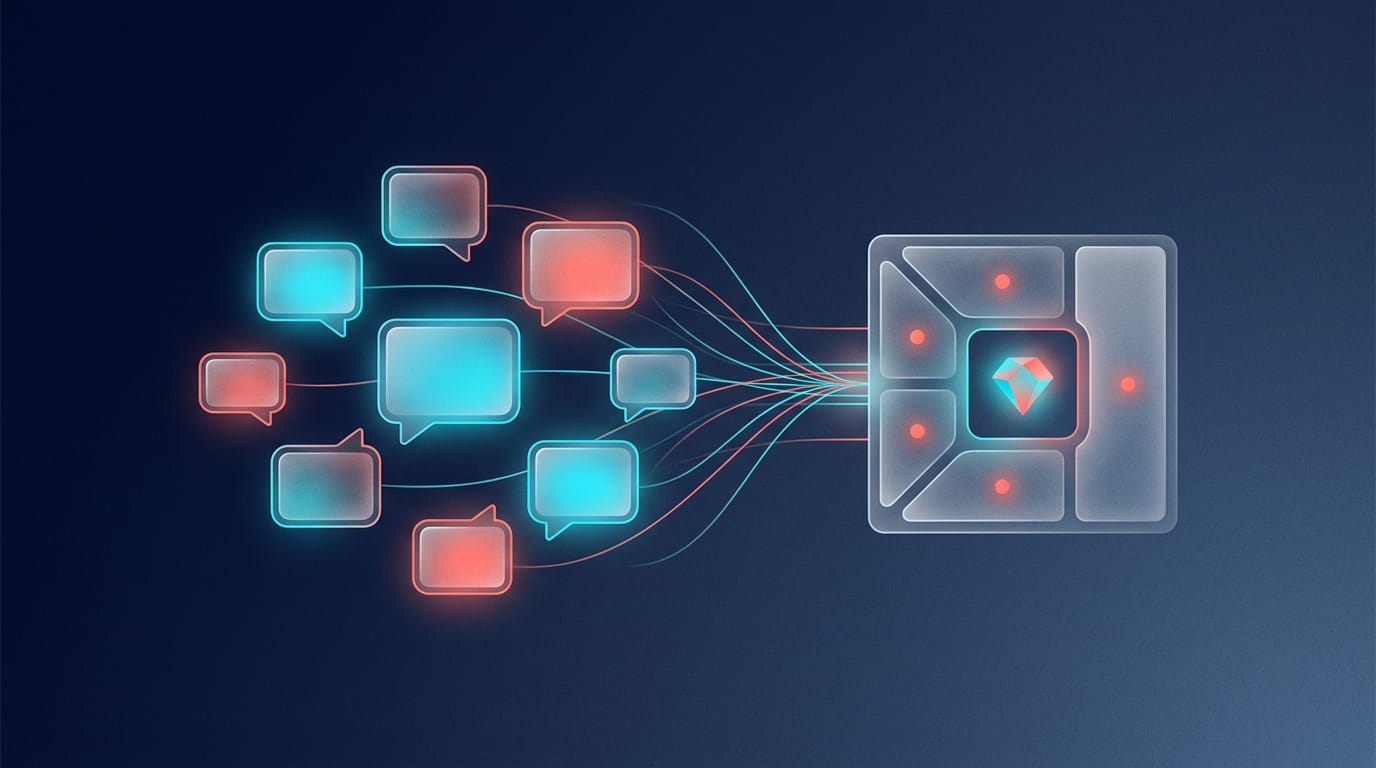
That is the thesis of this article. Audience pain points from YouTube comments are free, unsolicited, and specific. The problem was never access. It is extraction: pulling the three recurring frustrations that should shape your positioning out of hundreds of comments, without a week of manual scrolling.
Quick orientation, because two adjacent topics have their own guides. Turning comments into a publishing calendar is covered in YouTube comment section content plan. The broader framework on audience intent lives in what do YouTube viewers want. This piece is narrower: extracting pain points for positioning, messaging, and audience research. Comments in, pain points out.
Why brainstorms and surveys keep missing
Brainstorms produce internally generated guesses. Positioning needs externally verified friction. A team can spend a quarter convinced the audience cares about price, while the comment section shows the real blocker is trust in setup.
Surveys are the traditional fix, with real limits here: they are slow, cost money, and only capture the slice of your audience willing to fill out a form. Worse, a survey can only confirm hypotheses you already thought to ask about. The objections you never imagined stay hidden.
Voice of customer research methods exist to get around that. The standard toolkit is support tickets, sales call notes, interviews, and reviews:
"if you have any access to customer support tickets or sales call notes, mine those. Every question that gets asked more than twice is a post that will save someone (including you) from answering it 50 more times." — marketer on r/content_marketing
That instinct is right, and it generalizes. Support tickets and sales calls are private and hard to get at scale. Comment sections are the public layer of the same raw material: unsolicited, in the audience's own words, and available on your competitors' channels too. For a brand or agency, that makes YouTube comments the cheapest serious voice-of-customer dataset in existence.
What a pain point actually looks like in a comment section
Not every comment is a pain point. Praise is not one, small talk is not one. The signals that matter are the ones where a viewer describes friction:
- The same question under several videos. An unresolved gap the audience keeps running into. If three uploads attract the same question, it is structural.
- Complaints about how things are done. "Why does nobody explain the pricing part" is a positioning input with the exact wording your landing page should answer in.
- Disappointed or skeptical reactions. Expectations that were not met, stated plainly. These map directly to objections your sales or onboarding copy must handle.
- Suggestions phrased as wishes. "I wish someone would just show a real example" is unmet demand, pre-validated by the person typing it.
- Objections. "This would never work for a small team" is a trust barrier you can address head-on once you know it exists.
One occurrence is an anecdote. The same friction across several videos, or several channels, is a pattern. Recurrence is the filter. That is the difference between reading comments and mining them.
Where to mine: your own section and your competitors'
Start with your own channel if the brand has one with any history. It is the highest-trust source available: these people chose you, and their frustrations come with context you can act on immediately.
Then go outward. The sharpest positioning insights usually sit in comment sections you do not control, because when an incumbent misjudges its audience, the evidence is public:
"i also dig through competitor comment sections when they mess up launches or have angry customers... those complaint threads taught me more about positioning than any course could." — marketer on r/content_marketing
Complaint threads under a competitor's videos answer the two questions every positioning exercise circles around: what does the market already get, and where does it still hurt? The second answer is your entry point, written by the exact people you want to reach.
Comment sections capture the people who comment: they skew engaged and miss the silent majority. That is a reason to combine this source with your other voice-of-customer inputs, not a reason to skip it. An engaged commenter describing frustration is still a stronger signal than a guess.
The extraction method, step by step
Four steps, runnable by hand on a single channel.
1. Collect. Gather comments from the relevant videos: your own catalog, plus three to five competitor channels. Recurrence can only be judged across videos, so a single upload is never enough.
2. Classify. Sort comments by intent: question, praise, criticism, suggestion, or discussion. For pain point research, questions, criticism, and disappointed or skeptical reactions carry the signal.
3. Count recurrence. Tag each friction with the videos it appears under. One mention is an anecdote. The same question or complaint under three or more videos is a pain point. This step is why manual lurking feels hopeless.
4. Extract verbatim. Copy the recurring pain points in the audience's exact words. Paraphrasing destroys the value. The phrasing is the asset: it becomes your headline, your FAQ entry, your objection-handling copy, your positioning statement.
The mapping in practice:
| Comment signal | What it reveals | Research and positioning use |
|---|---|---|
| The same question under several videos | A recurring, unresolved gap | FAQ and landing copy answering it in the audience's words |
| Criticism of how incumbents do things | Where the market is underserved | Positioning against competitors, with receipts |
| "I wish someone would..." suggestions | Unmet demand, pre-validated | Offer and messaging framed around the exact wish |
| Disappointed or skeptical reactions | Unmet expectations and trust barriers | Objection handling in sales copy and onboarding |
| Specific praise with details | What genuinely delivers value | Double down here; build case studies around it |
AI audit of any YouTube channel
Drop a competitor's URL. In 5–15 minutes, get the full breakdown of what's working, what's broken, and exactly what to film next.
- 🎯Their content ideasVideos their audience keeps asking for that they never made
- ⚠️Their weak spotsExact topics and formats where viewers tune out or push back
- 💬Audience questionsStraight from their comment section — your next 10 scripts
- 📋A ready content planRanked backlog of what to film next, pulled from real demand signal
- 🔥Their superfansWho's emotionally invested in the channel and what gets them to talk
Just a URL and an email. Report lands in your inbox.
Where manual lurking breaks down
For a single channel with a modest comment section, one disciplined person with a spreadsheet can run this method. That is the honest ceiling of the manual approach.
A brand watching its own catalog plus three competitors is reading four comment sections. An agency doing that for five clients is reading twenty, weekly, deduplicating recurring questions across hundreds of videos while keeping wording verbatim. That is the wall described in those r/content_marketing threads: the insight is obviously there, and there is no systematic way to get it out without turning research into a part-time job. At that point the question stops being how to read comments and becomes what systematizes the reading.
Where OneTube fits (and where it stops)
OneTube automates the extraction layer for YouTube comment sections. It classifies every comment across five intents (question, praise, criticism, suggestion, discussion) and six emotions (grateful, eager, curious, disappointed, skeptical, neutral), so a comment section stops being noise and becomes a readable distribution. For pain point research specifically:
- Top questions, verbatim: your recurring frictions, surfaced and deduplicated
- Top criticism, verbatim, so complaints are visible without digging through threads
- Spy Mode runs the same analysis on any public competitor channel, the fastest way into those complaint threads and unmet-demand patterns
- Trends and topic clusters show which frustrations are rising and which topics the community returns to
- Superfans identify the engaged core whose words carry the most weight
Plans run Creator at $19/mo, Pro at $49/mo, and Studio at $119/mo, with Agency starting at $249/mo for multi-client rosters. Every plan starts with a 7-day free trial, no card required: enough time to run one full extraction pass on a real client before paying anything.
Now the honest part. OneTube does not run surveys and does not replace qualitative research like interviews or sales call reviews. It systematizes what the audience has already written in comments: questions, complaints, recurring frustrations. Reading the patterns is the tool's job. Interpreting them and turning them into a positioning decision stays yours. The strategy should come from you, built on words the audience already typed.
FAQ
How do I find audience pain points in YouTube comments?
Collect comments across several videos, classify them by intent, and keep the friction ones: repeated questions, complaints, disappointed or skeptical reactions, wish-style suggestions. Then count recurrence. One mention is an anecdote; the same friction across multiple videos is a pain point. Copy the recurring ones verbatim: the exact wording is what you reuse in positioning and copy.
What are the main voice of customer research methods?
The standard set is support tickets, sales call notes, customer interviews, surveys, and review mining. Public comment sections belong in the same category with one unique advantage: they exist on competitor channels too, so you can research an audience you have not reached yet. Each method has blind spots; serious teams combine them.
Can I extract pain points from a competitor's YouTube channel?
Yes, and that is often the richest source. Complaint threads under a competitor's videos show what the market already gets and where it still hurts. Spy Mode runs the same intent and emotion analysis on any public channel, so you see their recurring questions and frustrations without reading thousands of comments by hand.
Do I still need surveys if I can read comments?
Comments capture the engaged slice of an audience and miss the silent majority, so surveys and interviews still have a role. The practical order for most teams is to mine comments first, because that research is free and immediate, then spend survey budget confirming what comments surfaced rather than exploring blind.
How many comments do I need before a pattern is real?
There is no magic number. The test is recurrence across videos, not raw volume: a question appearing under three uploads is a pattern even in a small section, while ten identical comments under one video may be a reaction to that video alone. Tooling helps here, because cross-video recurrence is exactly the part a human loses track of.
Related reads
- YouTube comment section content plan, turning comments into a publishing calendar once pain points become topics
- What do YouTube viewers want? Decode audience intent, the wider framework on viewer intent behind the taxonomy used here
- YouTube competitor analysis, the full Spy Mode playbook for researching competitor audiences
- YouTube comment analyzer, how intent and emotion classification works on your own channel